
How to Search Cheboygan County Traffic Court Records
Cheboygan County does not run its own citation portal. Traffic cases filed in the county's district court are searched through MiCOURT, the statewide case-search system that the courts publish. You look up the county's case data by court code, not through a county-branded ticket site. That keeps the search simple, but it also means the ticket record and the state driving record are two different lookups in two different systems.
Before starting, gather what identifies the case. A citation number, the driver's full name, and the date the ticket was issued are the most useful. MiCOURT lets you search by case number or party name and then narrow by court, so a name search works when the citation slip is lost. Public access covers civil, traffic, criminal, domestic, and probate matters depending on the court queried, though the public view leans toward case and hearing data rather than downloadable filings. For the broader picture of how the county's case-search layer works, the Cheboygan County court records page walks through the same MiCOURT system in more detail.
- Open the Michigan Courts case-search page, the statewide entry point the county links for its district and circuit courts.
- Enter a case number if you have it, or switch to a party-name search using the driver's name.
- Use the Lower Court filter to narrow the results to the correct Cheboygan County court.
- Open the matching case to review hearing dates, the charge, and the disposition.
- Handle the next step from there: pay, enter a plea, or ask the district court counter for a certified copy the portal does not display.
The visible field set on the statewide page is small but enough to work with. The table below lists the controls the search page exposes.
| Field Label | Type | Required | Notes / Format |
|---|---|---|---|
| Case Number | Text | Not stated | Search by the exact case number. |
| Party Name | Text | Not stated | Search by a driver or party name. |
| Lower Court | Dropdown | Not stated | Filter to the correct county court. |
| Appellate Court | Dropdown | Not stated | Filter by appellate court. |
| Attorney Name | Text | Not stated | Attorney-name filter. |
| Bar Number | Text | Not stated | Attorney bar-number filter. |
| Advanced Search | Toggle | No | Opens more search options. |
| Submit Search | Button | Yes | Runs the query. |
Which Courts Handle Traffic Cases in Cheboygan County
Traffic matters in Cheboygan County are district court records first and state driving records second. The 89th District Court handles civil infractions and misdemeanor traffic offenses, from the ticket through the plea, hearing, and judgment. Judge Michael J. Ekdahl presides over that court, which serves both Cheboygan and Presque Isle Counties. The court runs a dedicated traffic division with its own phone line, which is the fastest way to confirm a court date or a plea deadline.
Two other channels round out the picture, and neither is a court. Driver history, points, and license status live with the Michigan Secretary of State, not the district court. Crash and collision reports are sold through the Michigan State Police, not the court either. So a single traffic incident can touch three offices: the district court for the citation, the Secretary of State for the driving record, and the state police for the crash report.
89th District Court – Traffic Division
870 South Main Street
Cheboygan, MI 49721
Traffic phone: (231) 627-8853
Mon–Fri 8:00 a.m.–4:30 p.m.
Types of Traffic Cases on Record
Not every ticket is treated the same way, and the type sets the deadline, the plea options, and whether a personal appearance is required. Cheboygan County's district court splits traffic matters into civil infractions and misdemeanor offenses, with commercial drivers and impaired-driving charges following their own tracks. Knowing the category before you respond keeps a minor ticket from turning into a default judgment.
- Civil infractions - Common moving and non-moving violations that are not crimes; answered by a plea within 21 days of the ticket.
- Misdemeanor traffic offenses - More serious violations that must be answered within 21 calendar days, and some may require a personal appearance.
- Commercial (CDL) violations - Offenses by commercial drivers, which carry stricter federal reporting and limited relief options.
- Impaired driving - DUI and DWI matters, which are charged as crimes and move through the criminal side rather than the civil-infraction track.
- Crash-related citations - Tickets tied to a collision, where a separate state crash report often exists alongside the court case.
What Cheboygan County Traffic Court Records Show
The county's public display is event-based rather than document-based, which means you will usually see the schedule and case references before you see any filed paper. A circuit and district docket display uses fields like party name, time, hearing information, case number, and CTN, the court tracking number that ties a case to its charge. Users should expect hearing scheduling and case metadata first, not a downloadable stack of filings. The county sources reviewed here did not expose a full traffic-citation result table, so the fields below reflect the confirmed public display layer.
| Field | What It Shows |
|---|---|
| Party Name | The driver or party named in the traffic case. |
| Time | The scheduled hearing time for the matter. |
| Hearing Info | The type of hearing and its place on the court calendar. |
| Case Number | The court's identifier for the traffic case. |
| CTN | The court tracking number linking the case to its underlying charge. |
What the display does not promise is the whole file. Michigan court guidance protects personal identifying information such as dates of birth, driver's license numbers, state ID numbers, passport numbers, and financial account numbers, so those attributes are withheld from the public view even when a case is open to search.
Paying or Contesting a Cheboygan County Traffic Ticket
A civil infraction starts a clock the day the ticket is issued. The driver has 21 days to enter a plea, and the plea can be an admission, an admission with explanation, or a denial. The county makes those pleas easy to file: in person, through a representative, by email to the district court, or by mail. Missing the window is the costly mistake, because if no plea is entered the court can enter a default judgment and add a late fee.
- Read the ticket to confirm whether it is a civil infraction or a misdemeanor, since the misdemeanor track has its own answer rules.
- Decide on a plea: admit, admit with explanation, or deny the civil infraction.
- File the plea within 21 days in person, through a representative, by email to the district court, or by mail.
- If you admit, pay the fine and any costs the court assesses on the citation.
- If you deny or admit with explanation, attend the hearing the court schedules and present your side.
- To challenge an informal hearing result, file the appeal within seven days of the decision.
Misdemeanor traffic offenses run on a similar but stricter timeline. They must be answered within 21 calendar days, and the court may require a personal appearance for certain offenses rather than a mailed response. Because the deadlines are short and the consequences add up, the traffic division phone line is worth a call before a deadline passes.
Note: If a driver does not respond to a civil infraction within 21 days, the court can enter a default judgment and add a $30 late fee to the amount owed.
Court Traffic Records vs State Driver Records
The single most useful thing to understand about traffic records here is that the court file and the driving record are not the same document. The court file is the case: the citation, the plea, the hearing, and the judgment in the 89th District Court. The driving record is a state history kept by the Secretary of State, showing convictions carried forward, points, and license status. One is a snapshot of a case; the other is a running history that follows the driver.
| Comparison Point | Court Traffic Record | State Driver Record |
|---|---|---|
| Record source | 89th District Court, in the statewide MiCOURT system | Michigan Secretary of State |
| What's in it | Citation, plea, hearing dates, case number, and disposition | Conviction history, points, and license status |
| Where to access | MiCOURT case search and the district court counter | The Secretary of State driving-record service |
| How to correct errors | File a correction with the court under the record-correction statute | Contact the Secretary of State driver-records unit |
Drivers who want history, points, or an official record extract go to the Secretary of State driving-record service, not the district court. The court can tell you what happened to a specific ticket; only the state can produce the certified driving history that employers and insurers ask for.
Cheboygan County Crash Reports and MSP TCPS
A collision adds a fourth kind of record that neither the court nor the Secretary of State sells. Traffic accident reports are obtained through the Michigan State Police Traffic Crash Purchasing System, the state's central portal for buying crash documents. The county sheriff's police-reports page points drivers to that system for collision reports rather than handling every request at the county counter.
The Michigan State Police Traffic Crash Purchasing System is where a crash report is located and purchased. The screenshot below shows its login and welcome screen.
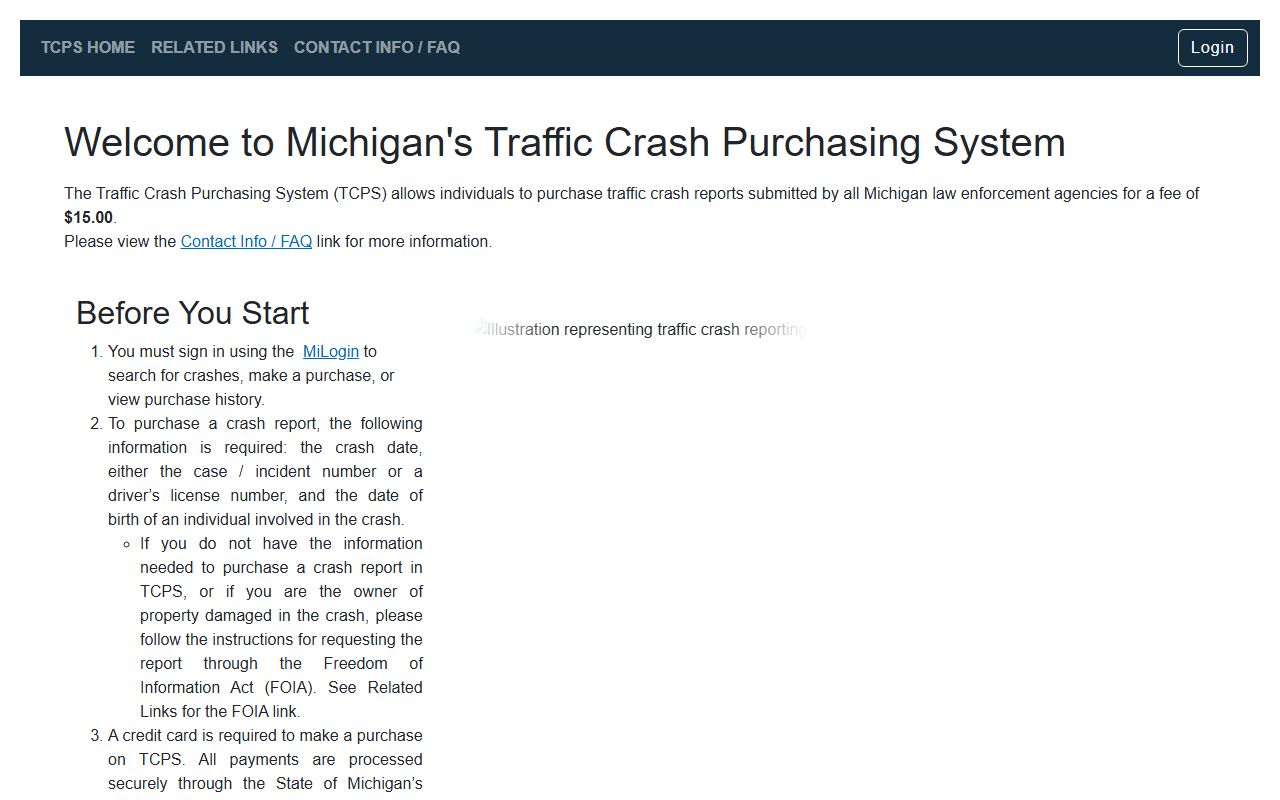
Keeping the three routes straight avoids wasted trips: a citation dispute goes to the district court, a driving history goes to the Secretary of State, and a crash report goes to the state police system. A single fender-bender can generate a ticket, a point on the driving record, and a crash report all at once, each held by a different office.
Accessing and Correcting Cheboygan County Traffic Records
Court records in Michigan are public by default, and traffic cases are no exception unless a specific exemption applies. The Freedom of Information Act sets the baseline right of access and the process for requesting records the online portal does not show. When a case is not viewable online, that same law governs how a written request to the county is handled, including the response deadlines the office must meet.
Errors do get into court files, and Michigan gives a route to fix them rather than leaving a driver stuck with a wrong entry. The record-correction statute covers how filing corrections are made to court documents, which matters when a name, a charge, or a disposition is recorded incorrectly on a traffic case.
Key Statutes:
Michigan Compiled Laws § 15.231 - Establishes the public's right of access to government records under the Freedom of Information Act.
Michigan Compiled Laws § 600.1428 - Governs record correction and filing corrections for court documents.
The correction statute is worth reading before contacting the court, because it frames what the clerk can and cannot change. The screenshot below shows the statute page for record correction in court files.
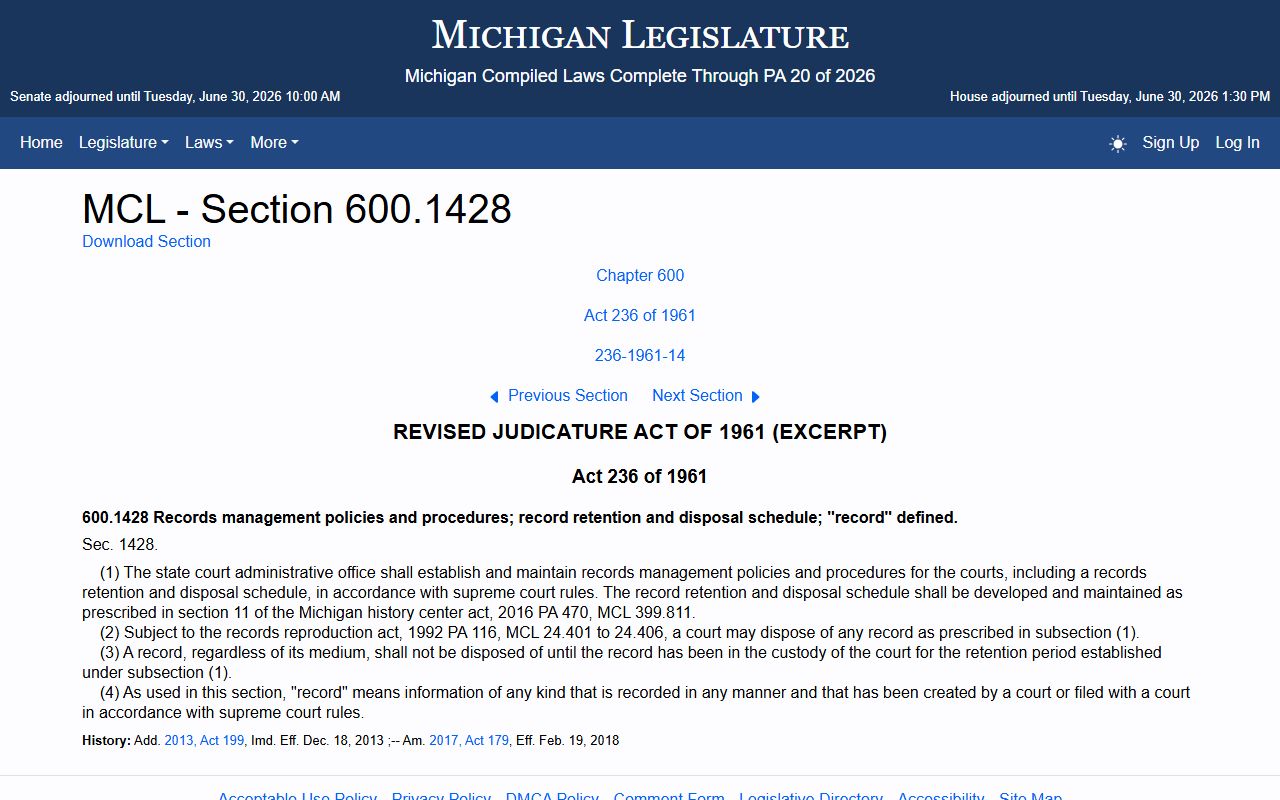
That statute is the anchor for fixing a court error. A separate mistake on the driving record itself, by contrast, is corrected through the Secretary of State, since the two files are kept by different agencies.
CDL and Commercial Driver Records
Commercial drivers face a tougher set of rules than other motorists, and a traffic ticket carries more weight against a CDL. Violations by commercial drivers are subject to stricter federal reporting, and the relief options that soften an ordinary ticket are limited or unavailable for many CDL offenses. That makes an early call to the district court traffic division especially important for a driver whose livelihood depends on the license.
The record split matters even more for these drivers. A CDL conviction posts to the state driving record and can affect the commercial endorsement long after the local court case is closed. Confirming both the court disposition and the Secretary of State entry is the only way to see the full effect of a commercial citation.
DUI and DWI Traffic Cases
Impaired-driving charges are not ordinary traffic tickets. In Cheboygan County a DUI or DWI is charged as a crime and moves through the criminal process, beginning in the 89th District Court and, for the most serious matters, continuing in the 53rd Circuit Court. The civil-infraction plea options and the mail-in response do not apply the same way, and a personal appearance is expected.
Because these cases follow the criminal track, the full case file, from arraignment through plea and sentencing, is documented as a criminal record rather than a simple citation. The complete picture, including charges, disposition, and sentence, lives on the Cheboygan County criminal court records page.
Sealing or Setting Aside Cheboygan County Traffic Records
Some traffic matters can eventually be cleared from a public record, though the path depends on what the offense was and how it was resolved. Michigan law provides mechanics for sealing and restricting court records, and the district court page points residents to the state Clean Slate resource for offenses that qualify. Clean Slate also sets some convictions aside automatically over time, which is why an old case may drop out of a public search on its own.
The sealing statute sets out how records are restricted from public view. The screenshot below shows that statute page.
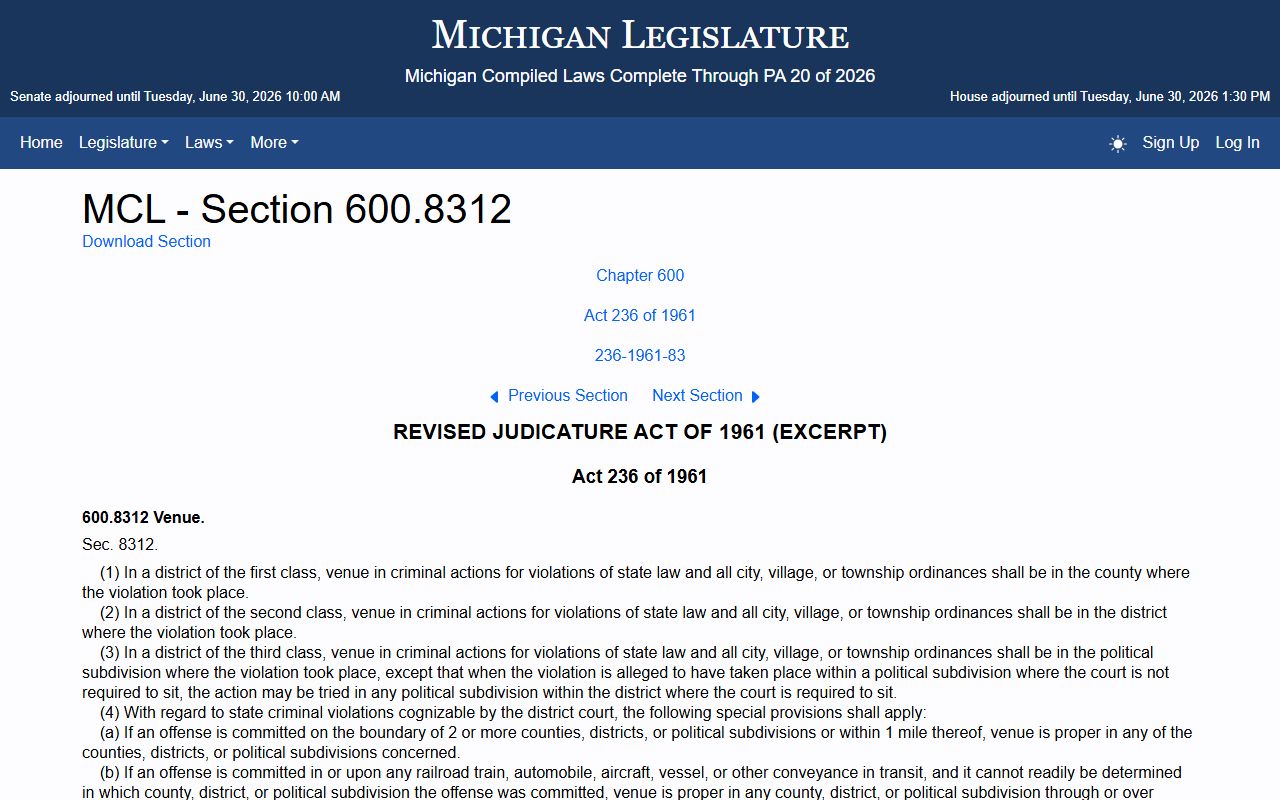
Eligibility is the catch. A civil infraction is handled differently from a misdemeanor, and impaired-driving convictions carry their own limits under Michigan's set-aside rules. Checking the Clean Slate resource the district court links, and confirming the case status in MiCOURT, is the practical first step before assuming a traffic record can be sealed.
Fees for Cheboygan County Traffic Records
The one traffic-record fee the county publishes plainly is the late fee that attaches to a default judgment, and it is the fee most drivers can avoid simply by responding on time. Copy fees for court records and the cost of an official driving record are set by the court and the Secretary of State respectively, and the county's reviewed materials do not list a fixed amount for those. The table below keeps to the documented figure and points to the right office for the rest.
| Item | Amount |
|---|---|
| Default-judgment late fee (civil infraction, no timely plea) | $30 |
| Copy of a traffic case record | Set by the 89th District Court; contact the traffic division |
| Official Michigan driving record | Ordered through the Secretary of State |
| Crash report | Purchased through the Michigan State Police system |
The takeaway is that a timely plea is the cheapest option on the list. Waiting past the 21-day window turns a fixed fine into a fine plus a late fee, and it can add a default judgment to the court record that then has to be addressed before the matter closes.