
What Cheboygan County Probate Records Cover
Probate is both a record type and a set of court duties. In Cheboygan County these matters run through the Probate/Family Court, not the county clerk's marriage and vital-record side. That split matters for anyone hunting a file, because a will or estate case will not sit on the same docket as a marriage license or a land record.
The court's own jurisdiction is broad. It covers estates of people who have died, guardianships, conservatorships, mental-health proceedings, adoptions, child custody, and civil actions that involve estates, wards, and trusts. The office also runs a will-and-trust depository, which lets a person leave a will or trust with the court for safekeeping during their lifetime. Each of those is its own record family, so a probate search means knowing which type of case you are looking for.
The county probate page pulls the useful pieces into one place. It gives the public search link, the office location, the judge, the staff contacts, and the public-record boundary together. That page is the anchor for the Cheboygan County Probate/Family Court, which lays out jurisdiction, the privacy notice, and the staff panel.
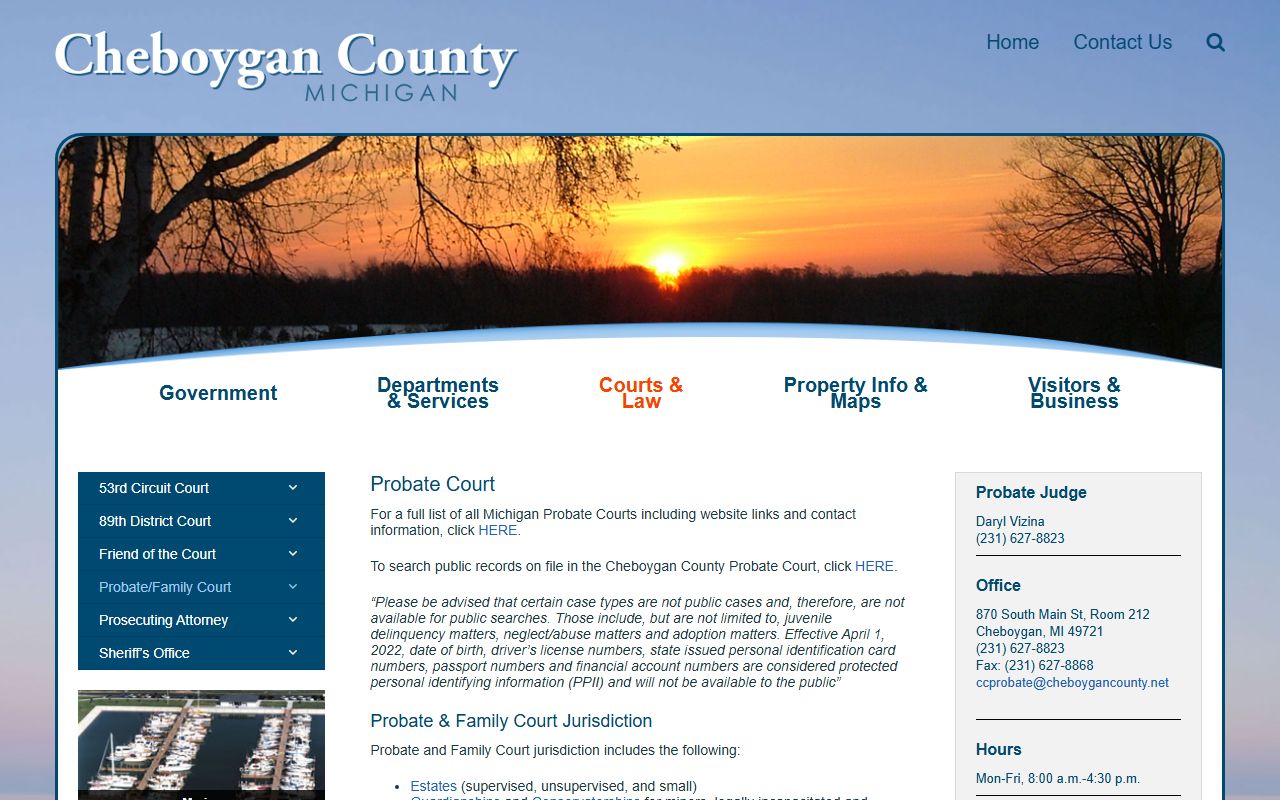
The page confirms that estates, guardianships, mental-health filings, and trust matters all route to this branch. It is the first stop for confirming a case type before running a public search or filing paperwork.
Probate Terms Defined
Probate filings use words that rarely come up in daily life. A quick glossary makes a public search easier to read, because the fields and case captions lean on these terms. The definitions below cover the ones that appear most often in Cheboygan County estate and guardianship files.
- Testator
- The person who made a will. When that person dies, the will is offered to the court and the estate is opened under their name.
- Executor
- The person named in a will to carry out its terms, gather assets, pay debts, and pass property to the heirs. Michigan filings often call this role the personal representative.
- Intestate
- Dying without a valid will. The estate is still handled by the court, but state law decides who inherits instead of a written will.
- Guardianship
- A court arrangement that gives one person legal authority to make personal and care decisions for a minor or an adult who cannot decide for themselves.
- Conservatorship
- A court arrangement that puts one person in charge of another person's money and property when that person cannot manage their own financial affairs.
How to Search Cheboygan County Probate Records
The public route for probate dockets runs through MiCOURT, the statewide case system. The probate page links straight to the Cheboygan County probate code, P16, so a searcher does not have to guess the court filter. The search is free, but the portal shows summary case data, not the full text of every filing. Details such as a complete inventory or an accounting usually mean a call or trip to the court office.
The entry point is the MiCOURT probate case search for court P16, which loads the Cheboygan County probate docket view. The screen is built for name and case-number lookups against the county's probate filings.
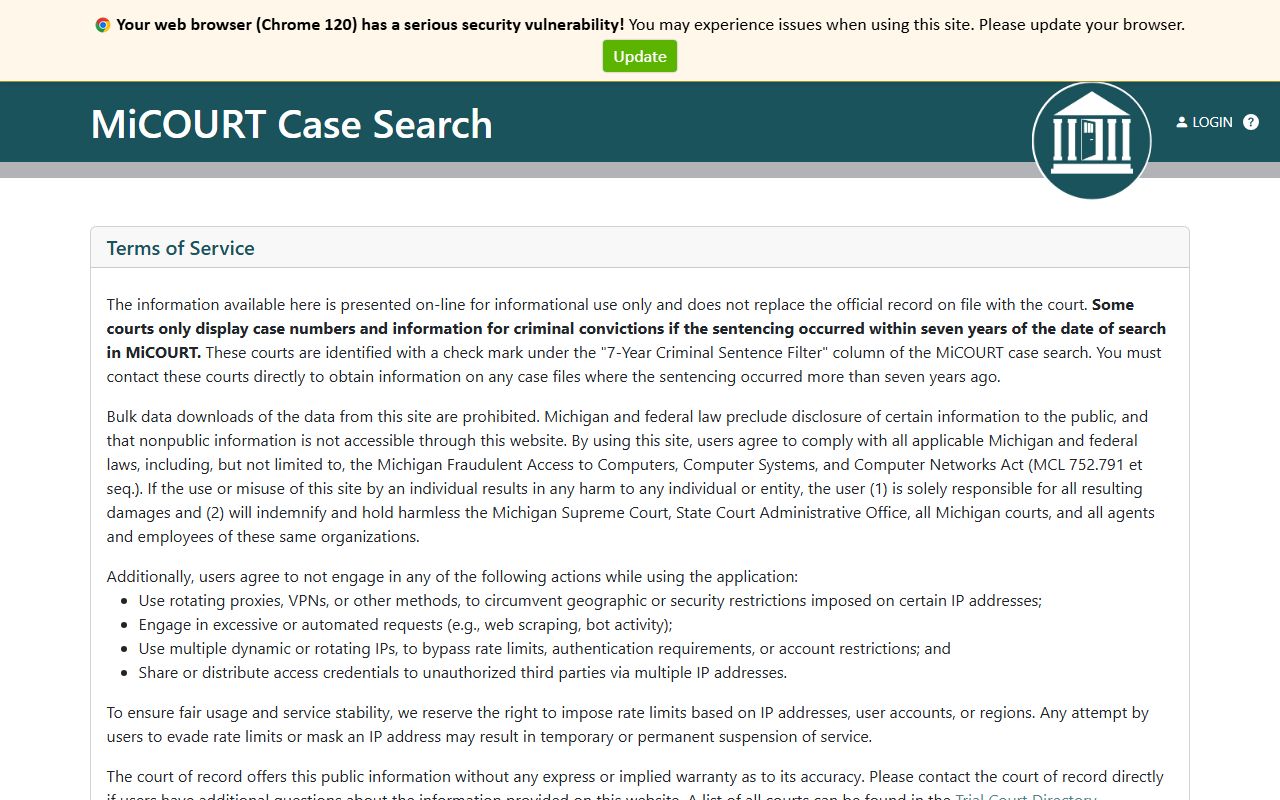
That P16 page is the correct starting point for public probate lookups in the county. It sits inside the same MiCOURT system used for circuit and district cases, so the search controls will feel familiar to anyone who has checked other Michigan court records.
The statewide search screen shares a common set of fields across court types. The table below lists the controls a probate searcher will meet.
| Field Label | Type | Notes |
|---|---|---|
| Case Number | Text | Search by exact case number. |
| Party Name | Text | Search by the name of a party to the case. |
| Attorney Name | Text | Filter by the attorney of record. |
| Bar Number | Text | Filter by an attorney's bar number. |
| Lower Court | Dropdown | Restrict results to a specific lower court. |
| Advanced Search | Toggle | Opens more search options. |
| Submit Search | Button | Runs the query. |
A basic lookup follows a short sequence once the P16 page loads.
- Open the MiCOURT probate search for court P16 and let the page finish loading, since it renders its controls with scripting.
- Enter a party name or the exact case number, adding an attorney name or bar number only if you need to narrow a common name.
- Submit the search, then open a result to view the summary case and hearing data the public screen allows.
Note: MiCOURT is a limited public view, so a result that looks thin often means the deeper record lives with the court office rather than online.
Cheboygan County Probate/Family Court Contact
One office handles probate in the county, and it shares the Main Street courthouse campus with the other trial courts. Judge Daryl Vizina presides over the Probate/Family Court. The office keeps a deputy probate register and several staff members with direct extensions, so a phone call can usually reach the right desk for a specific case type.
Cheboygan County Probate/Family Court
Judge Daryl Vizina
870 South Main St., Room 212
Cheboygan, MI 49721
Phone: (231) 627-8823
Fax: (231) 627-8868
Email: ccprobate@cheboygancounty.net
Hours: Monday to Friday, 8:00 a.m. to 4:30 p.m.
This office is the proper point for wills, estates, guardianships, conservatorships, and mental-health filings. For certified copies of some vital records tied to an estate, the county clerk remains the routing office, a split explained further down the page.
Probate Filing Fees in Cheboygan County
The county's probate page does not publish a line-by-line filing fee schedule for estates and guardianships. Probate filing fees in Michigan are set by court and clerk rules, and the exact amount depends on the case type and the value of an estate. The safe step is to confirm the current figure with the Probate/Family Court office before filing, rather than relying on a number that is not posted in the county's own sources.
What the county sources do document clearly is the certified-copy and recording route that surrounds probate. Certain vital records tied to an estate, such as a death certificate, are ordered through the county clerk and the state vital-record system rather than the probate court. Eligibility to receive a certified copy is set by statute, and the fee context lives on the state's vital-record pages.
| Item | Where It Is Set |
|---|---|
| Probate case filing fees | Set by court and clerk rules; confirm the current amount with the Probate/Family Court office. |
| Certified copies of court records | Requested through the court office or the county clerk depending on the record. |
| Certified vital records for an estate | Ordered through the county clerk and the state vital-record system under statutory eligibility rules. |
Eligibility to obtain a certified vital record is governed by state law. The controlling text is MCL 333.2882, which sets who may order a copy of a birth or death record and what an order must include.
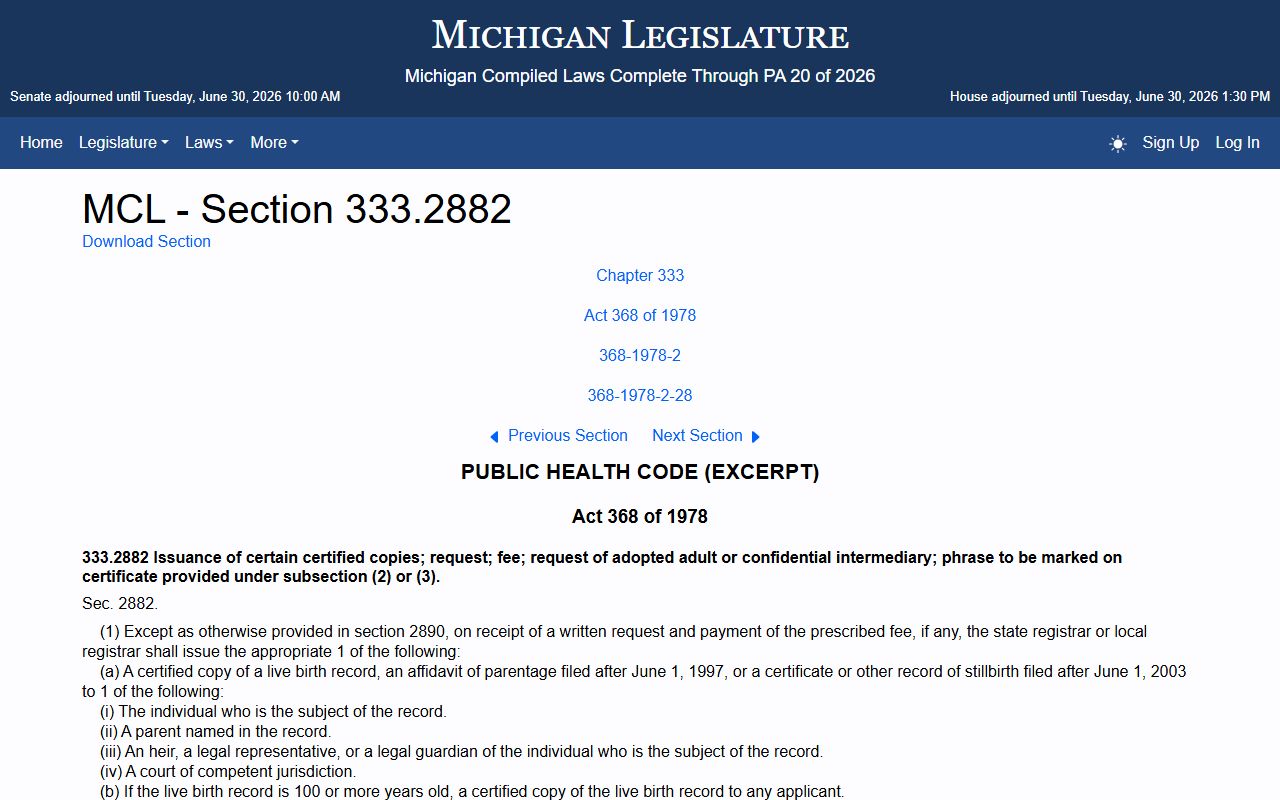
That statute is why an estate representative sometimes has to prove their standing before a death certificate is released. It also explains why vital records for an estate travel a clerk and state path rather than a straight probate-court path. The county clerk page carries the matching request details for anyone gathering those documents.
What Cheboygan County Probate Records Show
A probate file is a running account of how an estate or a protected person's affairs are handled under court supervision. The exact contents depend on the case type, but most estate files share a common shape.
- The will offered for probate, when one exists, along with any codicils.
- The order appointing a personal representative or a guardian.
- An inventory of the estate's property and its value.
- Accountings that show money coming in and going out during administration.
- Petitions, notices, and the final order closing the case.
Guardianship and conservatorship files follow a different rhythm. They center on the protected person, the appointed decision-maker, and the reports that show the arrangement is still needed and working. Because these cases can involve minors and vulnerable adults, more of their content sits behind confidentiality rules than a typical estate file.
The public MiCOURT view leans toward case identifiers and hearing data rather than full filings. A searcher should expect entry points around party names, case numbers, and hearing schedules, and should treat the absence of full pleadings or complete financial histories as a known limit of the public layer, not a gap in the underlying court file.
Restricted Cheboygan County Probate Records
Probate is one of the more confidential areas of the court system, and the county states its boundary plainly. Juvenile delinquency, neglect and abuse matters, and adoption are not public. Those categories stay closed even though they run through the same probate and family branch that handles open estate cases.
Beyond whole case types, certain personal identifiers are protected inside files that are otherwise open. The county lists dates of birth, driver's license numbers, state-issued personal identification numbers, passport numbers, and financial account numbers as data that is not public. That guidance follows the statewide standard the courts apply to filings, so it is a normal boundary rather than a local quirk. The Michigan Courts personal identifying information guidance sets out how these attributes are shielded across trial-court records.
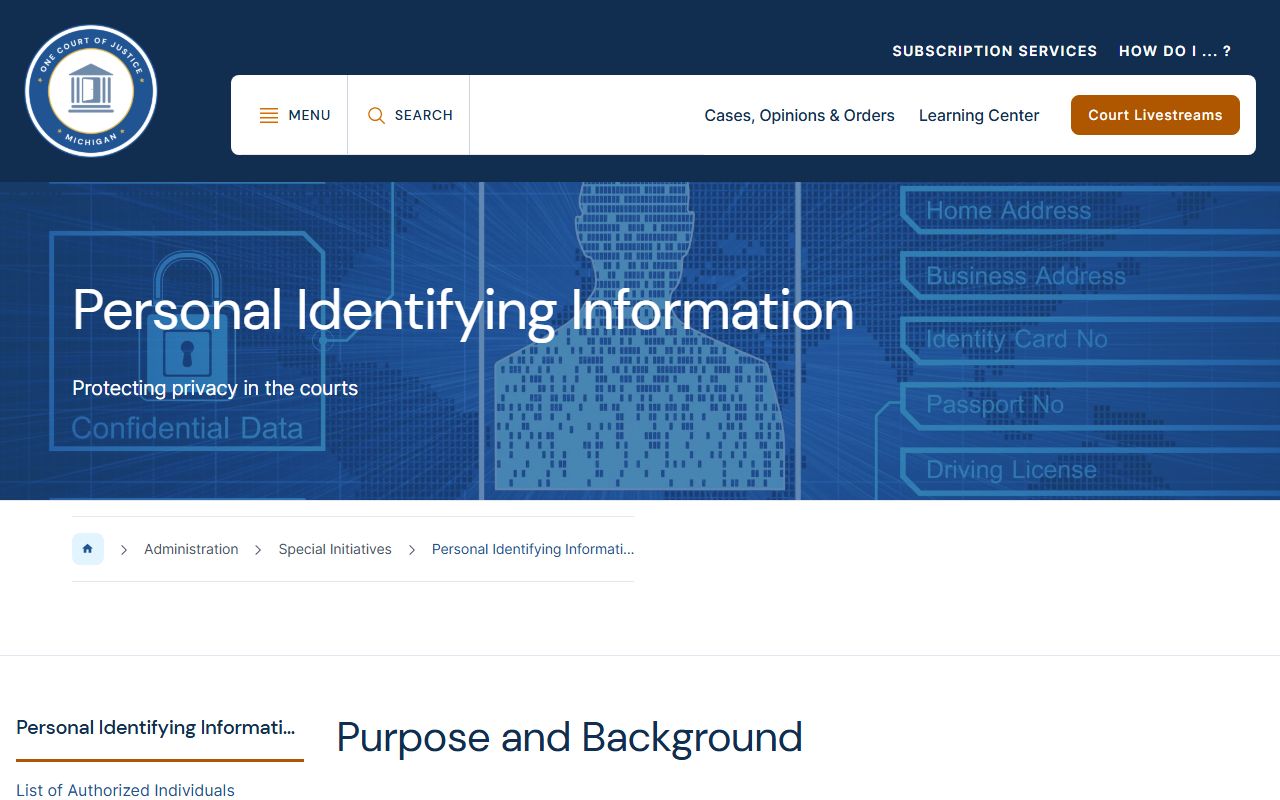
The takeaway for a searcher is simple. A public probate result will show case and hearing information while masking the sensitive identifiers, so a screen that hides a birth date or an account number is following the rule, not malfunctioning.
Juvenile records carry an added layer. Michigan law limits how juvenile adjudications are published and allows many to be set aside, which keeps them out of general public view. The governing text is MCL 712A.18e, the juvenile adjudication set-aside section.
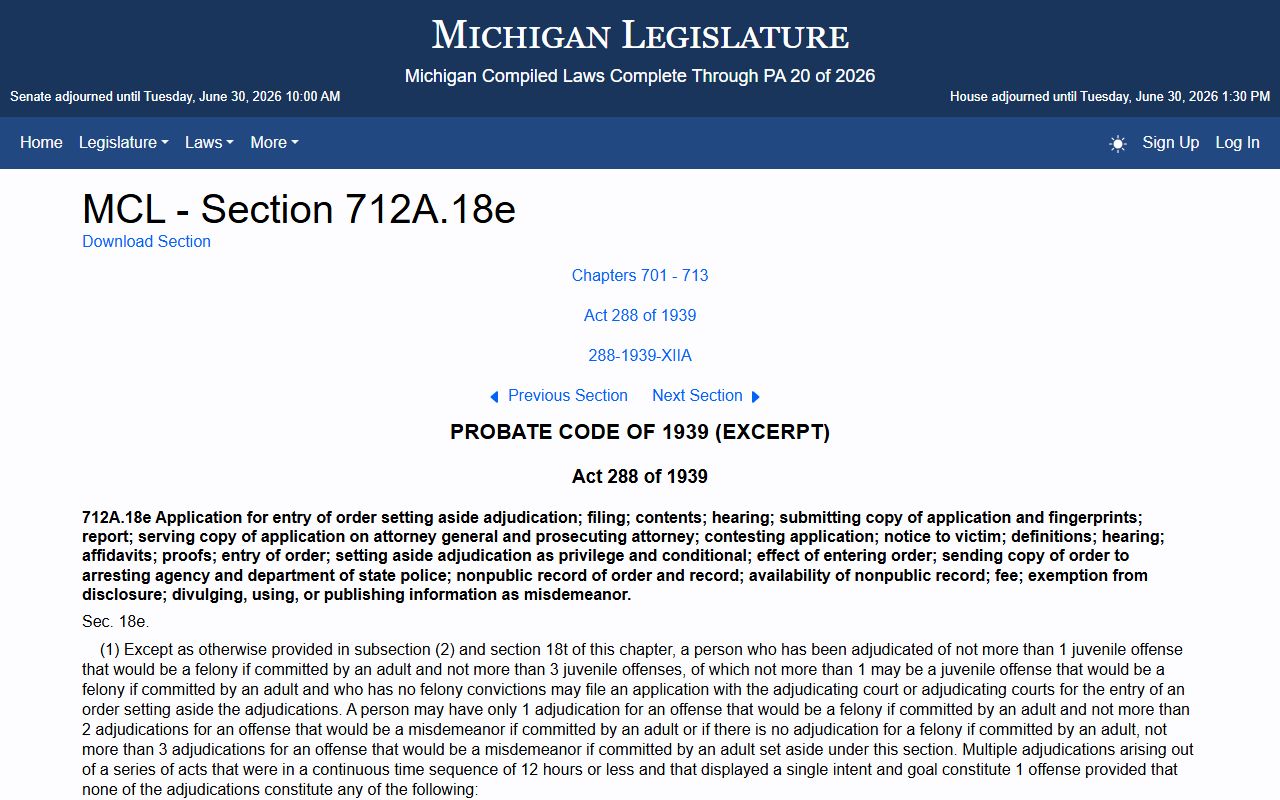
Because juvenile and adoption matters are sealed by design, they will not surface in a public P16 search. Anyone who needs confirmation on a nonpublic matter has to go through the court office and the proper legal channel rather than the online docket. For related family filings that are public, such as divorce and marriage records, the county's Cheboygan County marriage and divorce records guide covers the separate clerk and circuit-court paths, and certified copies often route through the County Clerk/Register of Deeds.