
Criminal Court Records in Cheboygan County
A criminal court record is the file the court opens the moment a charge is filed against a named defendant. It is not the same as an arrest blotter. The record follows the case itself, and it grows as the case moves. Every entry the court makes goes into it: the complaint, the charges as filed, each hearing, each motion, the plea or verdict, and the final sentence. In Cheboygan County the file is held by the court that hears the case, and the County Clerk acts as the clerk for the Circuit Court, so the clerk's office sits at the center of the county's court records.
Two trial courts produce criminal records here. The 89th District Court handles misdemeanors, civil infractions, and traffic matters, and it is also the front end for felonies. Felony cases open in the District Court for arraignment, a probable cause conference, and a preliminary examination. If the case is bound over, it moves up to the 53rd Circuit Court, where felonies are adjudicated and sentenced. That split is the single most useful thing to know before a search, because a felony leaves a trail in both courts while a misdemeanor usually stays in one. The charges filed after an arrest are covered in more depth on the Cheboygan County arrest and charge records page.
How to Search Cheboygan County Criminal Court Records
The county does not run its own free-text criminal search engine. Instead, both trial courts point the public to MiCOURT, the statewide Michigan Courts case-search system. The Circuit Court links its public search under court code C53, and the same platform covers civil, traffic, criminal, domestic, and probate matters depending on the court chosen. You are searching the state's case-management layer using the county's court code, so the search model is consistent across Michigan.
- Open the Michigan Courts case-search portal and choose whether to search by party or by case number.
- Enter the defendant's name in the Party Name field, or type the exact case number if you have it.
- Use the Lower Court dropdown to narrow the search to the correct Cheboygan County court, then filter by date where the option appears.
- Open the matching case to read the docket entries, the charges, and the disposition.
- Ask the County Clerk's office for a certified copy if you need a court-accepted document.
MiCOURT is a limited public view, not a full document dump. It tends to show case metadata and hearing scheduling before it shows underlying filings. The Circuit Court also livestreams public hearings on YouTube and posts public docket display links, so some criminal hearings can be watched online even when the paper file is not posted. When the portal falls short, the clerk counter, the court office, and the prosecutor are the next channels.
| Field Label | Type | Notes |
|---|---|---|
| Case Number | Text | Search by exact case number. |
| Party Name | Text | Search by defendant or party name. |
| Lower Court | Dropdown | Filter to the correct county court. |
| Attorney Name | Text | Attorney-name filter. |
| Bar Number | Text | Attorney bar-number filter. |
| Advanced Search | Toggle | Opens more search options. |
Stages of a Cheboygan County Criminal Case
A criminal case moves through fixed stages, and each stage leaves its own mark in the record. Reading the file in that order makes it far easier to understand. The prosecutor charges the case, the court arraigns the defendant, felony cases pass through a probable cause conference and a preliminary examination, and the matter ends in a plea or trial, then a disposition and a sentence. The county's prosecutor office describes this arc as its "court process and proceedings."
Case flow: Charges Filed › Arraignment › Probable Cause Conference / Preliminary Exam › Plea or Trial › Disposition › Sentencing
The county prosecutor's office lays out how a charge travels through the courts on its court process and proceedings page. The screenshot below shows how the office frames each stage of a Cheboygan County criminal matter.
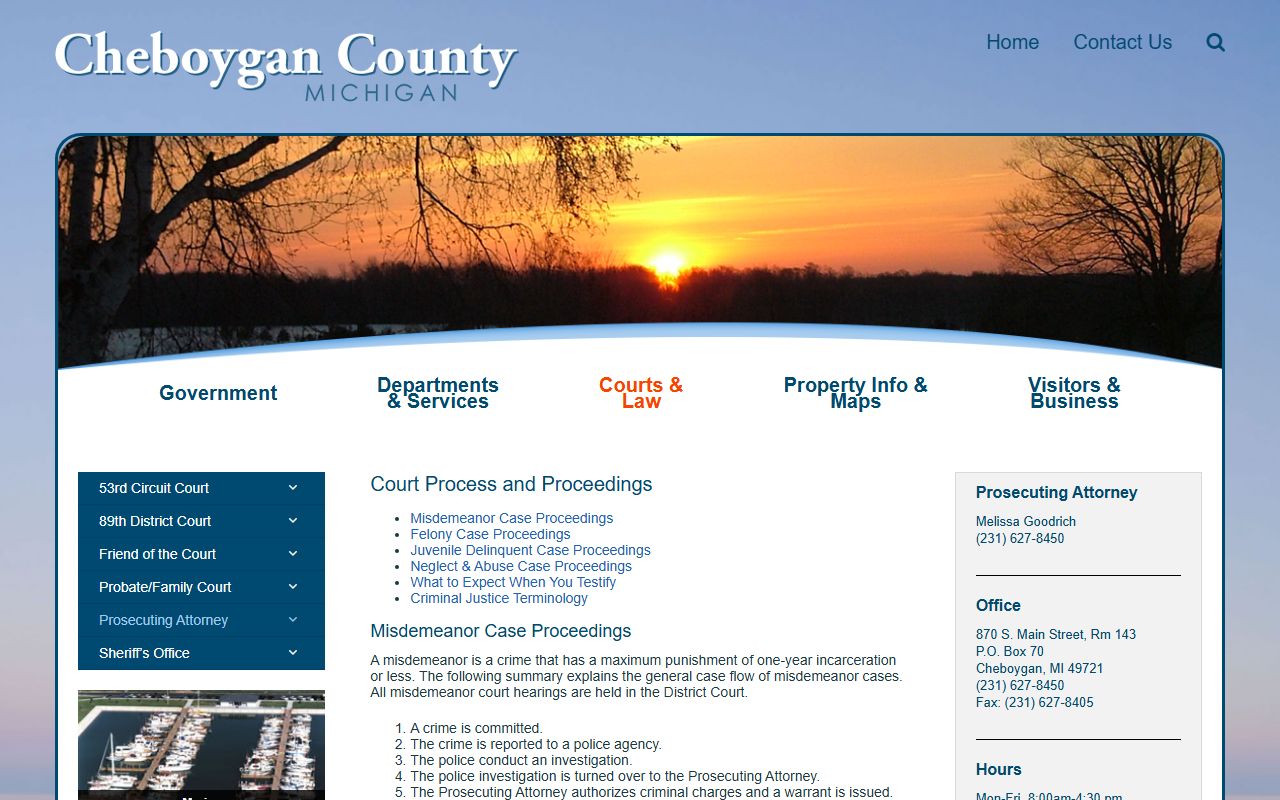
That process map is why a felony file reads differently from a misdemeanor file. A felony carries District Court front-end entries and then a full Circuit Court record, while a misdemeanor usually holds a single court's entries from charge to sentence.
| Stage | What Happens |
|---|---|
| Charges Filed | The prosecutor files a complaint naming the defendant and the charges. This opens the case. |
| Arraignment | The court reads the charges, sets or reviews bond, and the defendant enters an initial response. |
| Probable Cause Conference / Preliminary Exam | For felonies, the District Court tests whether the case should be bound over to the Circuit Court. |
| Plea or Trial | The defendant pleads, or the case is tried before a judge or jury. |
| Disposition | The court records the outcome: guilty, not guilty, dismissed, or a plea result. |
| Sentencing | The court imposes any jail, probation, fines, costs, or restitution. |
What a Cheboygan County Criminal Court Record Shows
A criminal case file in Cheboygan County reads as a chain of events, not a single page. It carries the charge or charges, the arraignment, any probable cause conference and preliminary examination, the plea, pretrial settings, hearings, motions, the final disposition, and the sentence with any probation conditions and restitution. The public online view usually surfaces case numbers, party names, hearing dates, and outcomes first, with full filings held at the court counter. The table below breaks the file into the fields a searcher will most often use.
| Field | What It Shows |
|---|---|
| Case Number | The unique court identifier that ties every filing and hearing together. |
| Court Level | Whether the matter sits in the 89th District Court or the 53rd Circuit Court. |
| Defendant | The named person charged, with attorney of record where listed. |
| Charges | Each offense as filed, with the statute or ordinance cited and severity level. |
| Hearings | Dated entries for arraignment, conferences, motions, and trial settings. |
| Plea | How the defendant responded: guilty, not guilty, or no contest. |
| Disposition | The final outcome of each charge in the case. |
| Sentence | Jail time, probation, fines, costs, and restitution ordered. |
Not every field is fully public. Michigan court guidance protects personal identifiers such as dates of birth, driver's license numbers, state ID numbers, passport numbers, and financial account numbers, so those attributes are redacted from the public view even when the case itself is open.
The Prosecutor's Role in Cheboygan County Criminal Records
The criminal record does not live only in the court docket. The Cheboygan County Prosecuting Attorney's office runs a companion set of materials that are part of the public criminal process. Melissa Goodrich is the prosecuting attorney, and Anthony Juillet is the chief assistant. The office handles charging decisions and also victim rights, restitution, victim-impact statements, community mediation, and personal protection order routing. For many cases, those documents explain why a sentence includes restitution or why a protective order sits alongside a charge.
The Cheboygan County Prosecuting Attorney page is the hub for these services and contacts. Its layout, shown below, groups the office's criminal-process and victim-service links in one place.
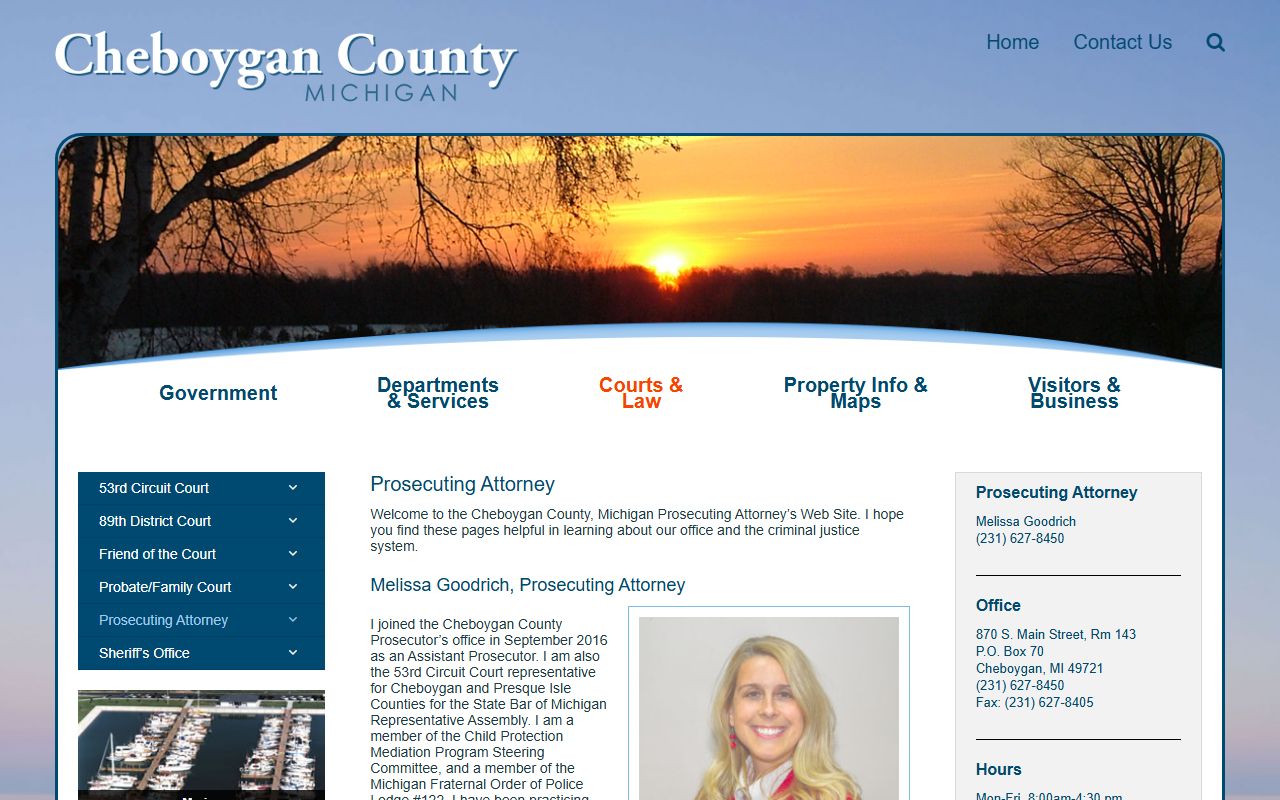
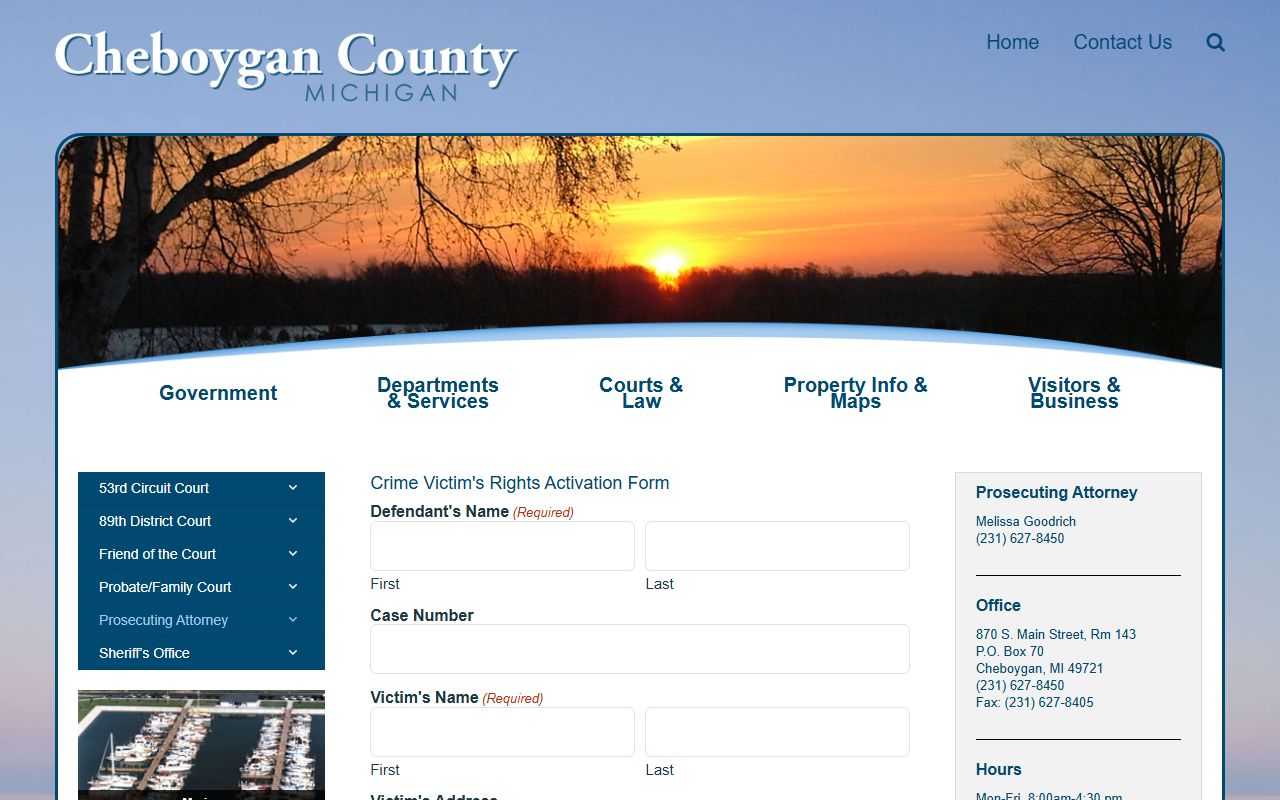
That page matters to a records searcher because the victim side of a case can shape the file. A crime victim can assert formal rights early in the case. The office publishes a dedicated crime victims rights form, pictured here, for that purpose.
Domestic and safety-related charges often travel with a protective order. The prosecutor office keeps personal protection order information and forms, shown below, so a victim can request a PPO while a criminal matter is pending.
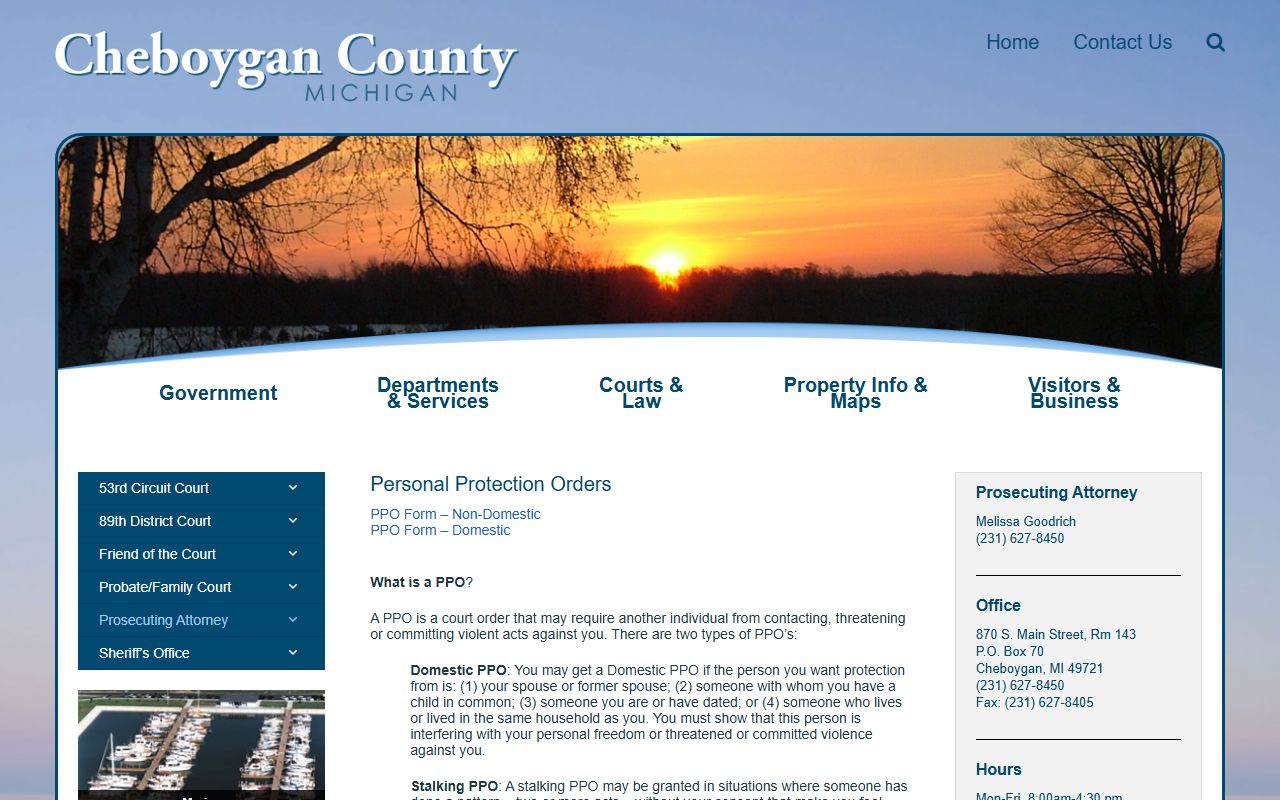
A PPO is a separate civil order, but it frequently appears in the same story as a criminal charge, and it can affect bond conditions the court records at arraignment.
Charges vs. Convictions in the Record
Being charged is not the same as being convicted, and the record reflects that gap. A criminal court file can show charges that were reduced, dropped, dismissed, or that ended in acquittal. A charge is only an accusation. A conviction is the court's finding of guilt after a plea or a verdict. Reading the disposition line for each charge is the only reliable way to tell them apart, because a case can hold several charges with different results.
| Charge | Conviction | |
|---|---|---|
| Stage | Accusation at filing | Result after plea or verdict |
| Burden of Proof | Probable cause | Beyond a reasonable doubt |
| Can Change | Amended, reduced, or dropped | Stands unless appealed or set aside |
| Public Record | Yes | Yes |
This distinction is the reason a name that appears in a charge record is not proof of guilt. Anyone relying on the file for a decision should read each disposition, not just the list of charges as filed.
Reading Dispositions and Sentences
The disposition is where the case lands. Common dispositions include guilty, not guilty, dismissed, and no contest, sometimes shown as nolo contendere. Some matters resolve through deferred or diversion arrangements that can change how the final entry reads. The sentence follows the disposition and can combine jail time, probation, fines and court costs, and restitution paid to a victim. In felony cases sentenced by the Circuit Court, the sentence lines are usually the most detailed part of the file.
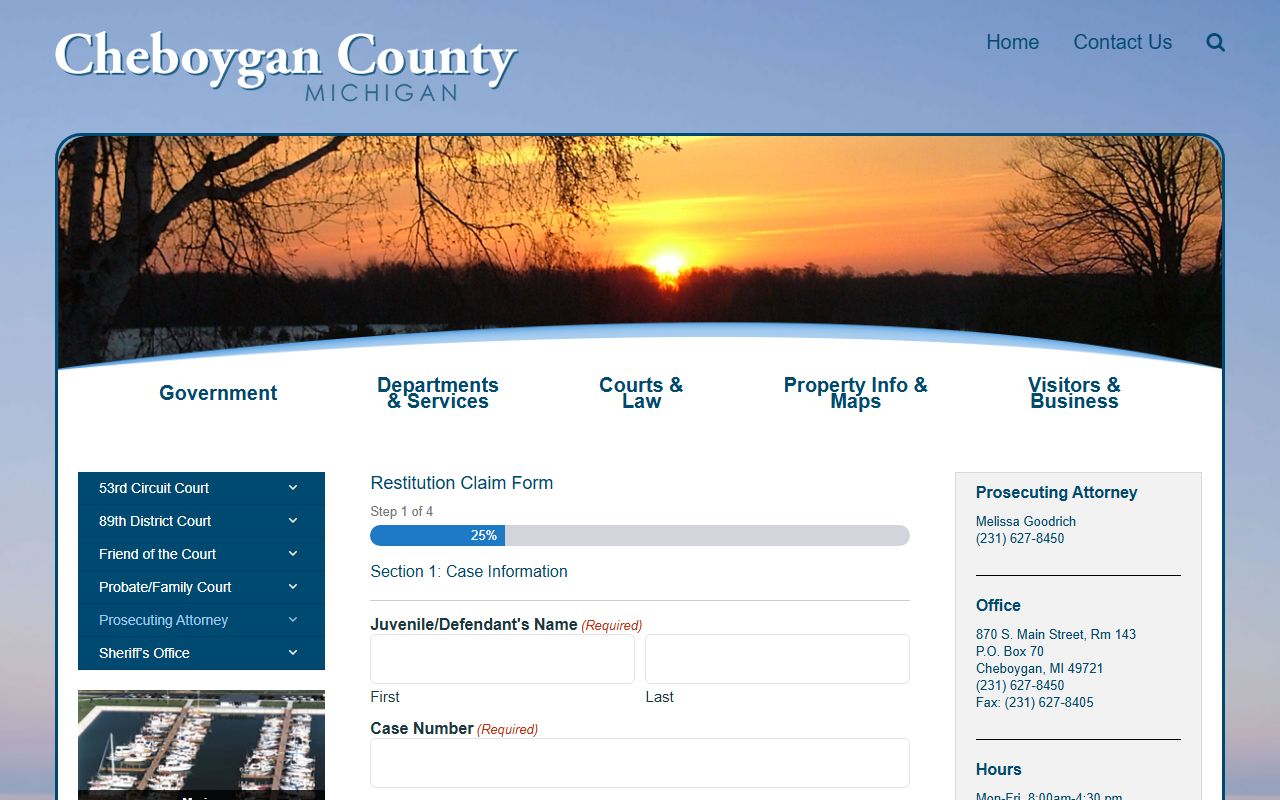
Restitution is a formal part of many Cheboygan County sentences, and the prosecutor office publishes the restitution form used to document a victim's losses. The form, shown here, feeds the dollar figure the court can order at sentencing.
Sentencing can also weigh what the crime cost the victim. A victim may file a victim impact statement, pictured below, which the court can consider before it imposes a sentence.
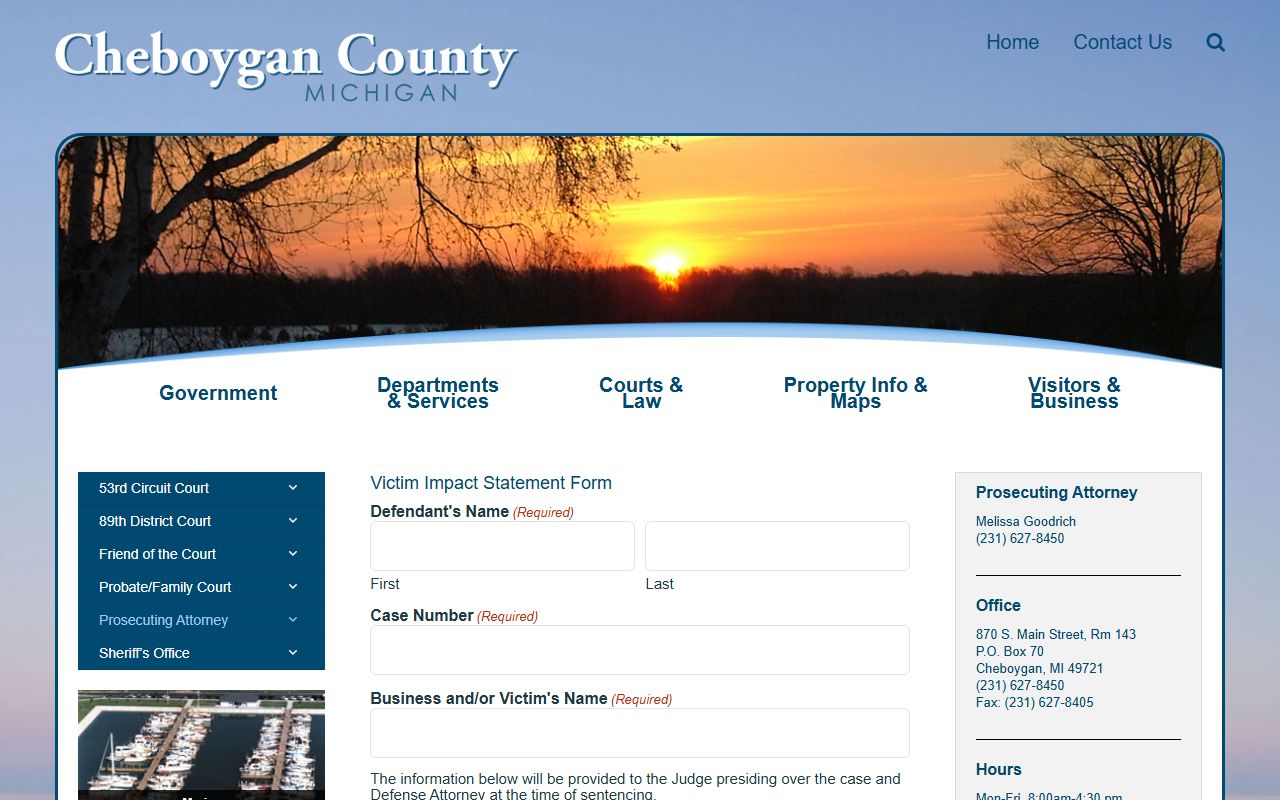
When a statement or restitution order is part of a case, it explains sentence terms that a bare charge list never would.
Sealed vs. Expunged Cheboygan County Records
People often use "sealed" and "expunged" as if they mean the same thing, but they do not. A sealed record is hidden from public view while it still exists in the system. An expunged, or set-aside, record is treated as if it never happened for most purposes. Michigan handles this through its set-aside law rather than a general sealing statute, and the path depends on the offense and on time elapsed since the case closed.
| Sealed | Expunged / Set Aside | |
|---|---|---|
| Visibility | Hidden from public view | Treated as if it never occurred |
| Law Enforcement | Limited access remains | Very limited, non-public access |
| Michigan Path | Court order in narrow cases | Set-aside under MCL 780.621 |
| Eligibility | Depends on case type and judge | Depends on offense, count limits, and waiting period |
Adult convictions can be set aside under MCL 780.621, which sets the eligibility rules and waiting periods for clearing qualifying convictions. Juvenile adjudications follow a separate track under MCL 712A.18e. Michigan's Clean Slate program also allows some convictions to be set aside automatically over time, without a filing, which is why an old case may drop out of a public search on its own. The District Court page links the state Clean Slate resource for residents who want to check eligibility.
Note: A set-aside removes a conviction from most public records, but some agencies keep a non-public copy for narrow law-enforcement and licensing uses.
Public Access to Cheboygan County Criminal Records
Most criminal court files in Cheboygan County are public. Adults can search the case-management system, watch livestreamed hearings, and request copies at the court counter. That openness rests on Michigan's public-records framework and on the state's court records rules, which together set what the public may see and what stays out of reach. When an online search comes up short, a formal request to the county or a court office is the backstop, since not every filing is posted online even for a public case.
Key Statutes:
Michigan Code § 15.231 - Michigan's Freedom of Information Act establishes the public's right to inspect and copy government records.
Michigan Code § 15.234 - the same act sets the exemptions and limits that keep sensitive or non-disclosable records private.
The Michigan Courts also publish personal identifying information guidance that keeps items like birth dates and license numbers out of the public file. All court records that are not exempt can be viewed, but a searcher should expect summary fields online and full documents at the counter. The clerk and the courts handle certified copies for anyone who needs a court-accepted version.
Background Check Considerations
Reading a criminal court file for personal knowledge is very different from running a background check for a legal decision. Casual lookups on MiCOURT are fine for curiosity, following a case, or confirming a hearing date. Decisions about hiring, housing, credit, or insurance are governed by the federal Fair Credit Reporting Act, which requires an accredited consumer reporting agency and specific consumer protections. A raw court search does not meet that standard, and charges that never became convictions can mislead anyone who skips the disposition.
Important: This resource is not a consumer reporting agency under the FCRA, and its information may not be used for employment, tenant, credit, or insurance screening.
Restricted Criminal Court Records in Cheboygan County
Some criminal matters are simply not public, no matter where a searcher looks. Juvenile cases handled through the Probate and Family Court are the clearest example. The county states plainly that juvenile delinquency, along with neglect, abuse, and adoption matters, is not public. Sealed and set-aside cases drop out of the public view by law, and ongoing matters can hold entries the court withholds until they resolve. Protected personal identifiers stay redacted even in open files.
When a case is not visible online, the record may still exist through a controlled channel. A formal request to the county or the right court office is the correct route, and the prosecutor office can help with the victim-service and protective-order side of a case. For a broader look at every county record type and where each one lives, the Cheboygan County court records overview maps the full set of channels. Where a matter turns on custody or an active warrant, human contact with the sheriff or the court, rather than an online portal, is the reliable path.