
How to Search Cheboygan County Court Records
The main court search route in Cheboygan County is MiCOURT, the statewide case-search system, not a county-built engine. The county links its 53rd Circuit Court records search and its Probate/Family Court search to the same state platform, each tagged with a court code. That means a Cheboygan County court records search is really a search of Michigan's case-management layer filtered to the local court. The state Michigan Courts case-search page covers civil, traffic, criminal, domestic, and probate matters, depending on which court you point it at.
Before starting, it helps to have a party name or a case number. A name search casts a wider net, while a case number lands you on a single file. The county's own website ties every court, the clerk, and the sheriff back to the same address, so it works well as a launch point when you are not sure which office holds a record.
The county homepage at cheboygancounty.net is the front door to those court pages and public-safety contacts.
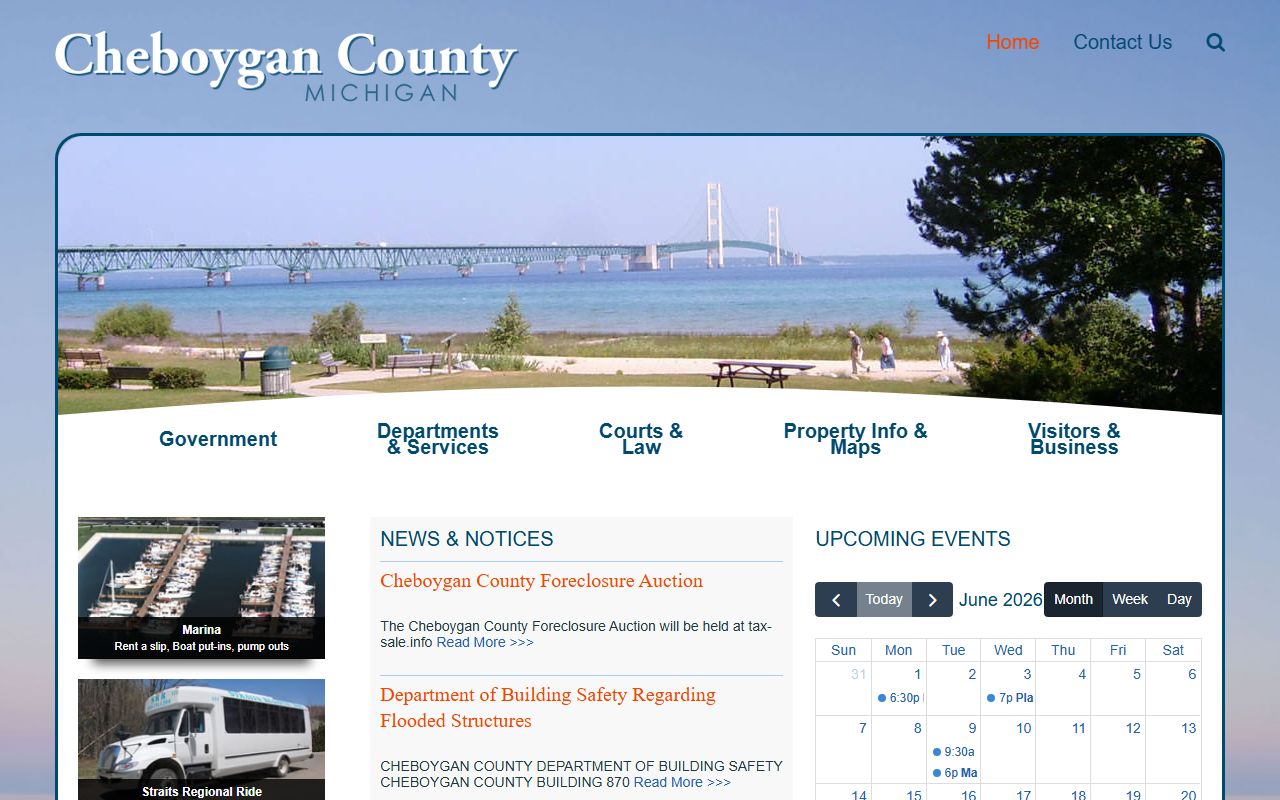
The county homepage groups the courts, the clerk, and law-enforcement offices under one menu, which mirrors how the physical courthouse campus is arranged. From there, the practical search sequence looks like this:
- Open the MiCOURT case-search page and choose whether you are searching a trial court by name or entering a specific case number.
- Enter a party name or the exact case number, then set the court level so you are looking at the right court for the case type.
- Narrow the results using the lower-court, attorney, or bar-number filters when a name returns many matches.
- Review the case and hearing entries that come back, since the public display is usually hearing-focused rather than document-by-document.
- Contact the clerk or the originating court counter for a certified copy or for any file that does not appear in the public view.
The state portal exposes a compact but useful field set. The visible controls on the Michigan Courts search page are listed below.
| Field Label | Type | Notes |
|---|---|---|
| Case Number | Text | Search by an exact case number. |
| Party Name | Text | Search by the name of a person or business. |
| Appellate Court | Dropdown | Filter by an appellate court. |
| Bar Number | Text | Filter by an attorney bar number. |
| Attorney Name | Text | Filter by attorney name. |
| Lower Court | Dropdown | Filter by a lower court. |
| Advanced Search | Toggle | Opens more search options. |
| Submit Search | Button | Runs the query. |
The Cheboygan County Judicial System
Michigan splits trial work across three benches, and Cheboygan County uses all three. The 53rd Circuit Court hears felonies, civil cases of $25,000 or more, and family matters such as divorce, custody, paternity, child support, and personal protection orders. The 89th District Court handles misdemeanors, civil infractions, small civil claims, summary proceedings, traffic, and the front end of felony cases. The Probate and Family Court handles estates, guardianships, conservatorships, mental-health proceedings, adoptions, and juvenile-family matters.
The record path matters as much as the court name. A felony often begins in District Court with arraignment, a probable-cause conference, and a preliminary examination, then moves up to Circuit Court on bindover. Traffic and misdemeanor files usually stay in District Court. Probate files sit in their own workflow and are not folded into the circuit docket. Cheboygan County has no separate municipal or village courts in the county material, so there is no competing city-court bench to check.
Case flow: Arrest or filing › 89th District Court › 53rd Circuit Court › Michigan Court of Appeals › Michigan Supreme Court
Because MiCOURT is the shared statewide layer, the same search screen reaches each of these benches once you set the court. The 53rd Circuit Court case-search entry and the probate search both run on that platform.
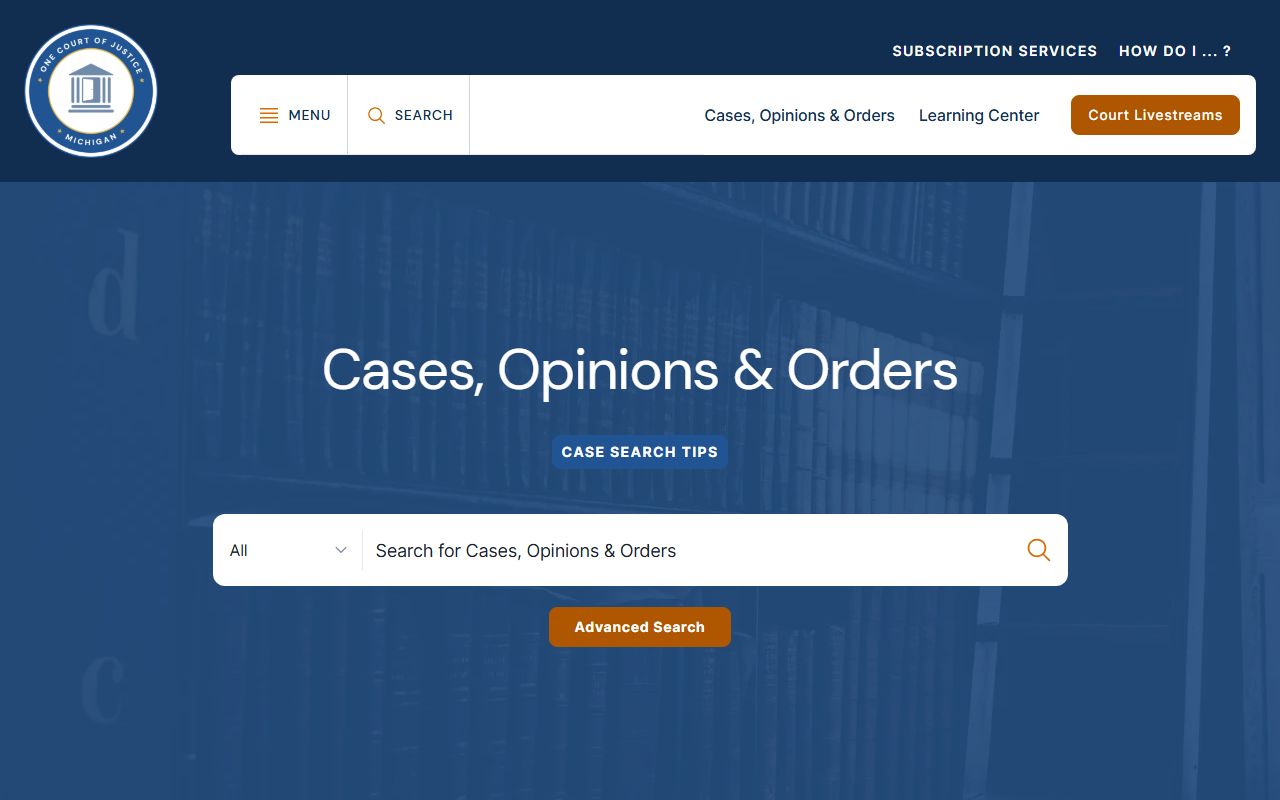
The statewide search page is the single window into all three Cheboygan County benches, which keeps the lookup process consistent across case types. The table below compares what each local court handles.
| Court | Handles | Common Case Types |
|---|---|---|
| 53rd Circuit Court | Higher civil, felony, family | Felonies, civil $25,000+, divorce, custody, support, PPO |
| 89th District Court | Lower criminal, minor civil, traffic | Misdemeanors, civil infractions, small claims, felony front end |
| Probate/Family Court | Estates and protective matters | Estates, guardianships, conservatorships, mental health, adoptions |
Types of Court Records Available in Cheboygan County
The county record set breaks into a handful of practical buckets, and each one tends to live with a specific court or office. Civil files run through Circuit Court for larger disputes and District Court for smaller ones. Criminal files split by severity, with misdemeanors in District Court and felonies finishing in Circuit Court. Family, probate, traffic, and vital records each follow their own channel.
Knowing which court produces a record saves time, because a name that returns nothing in one court may be sitting in another. The county property and mapping pages also help orient a records search around land, addresses, and parcels tied to a case.
The county's property and maps hub is a useful companion when a court file touches real estate.
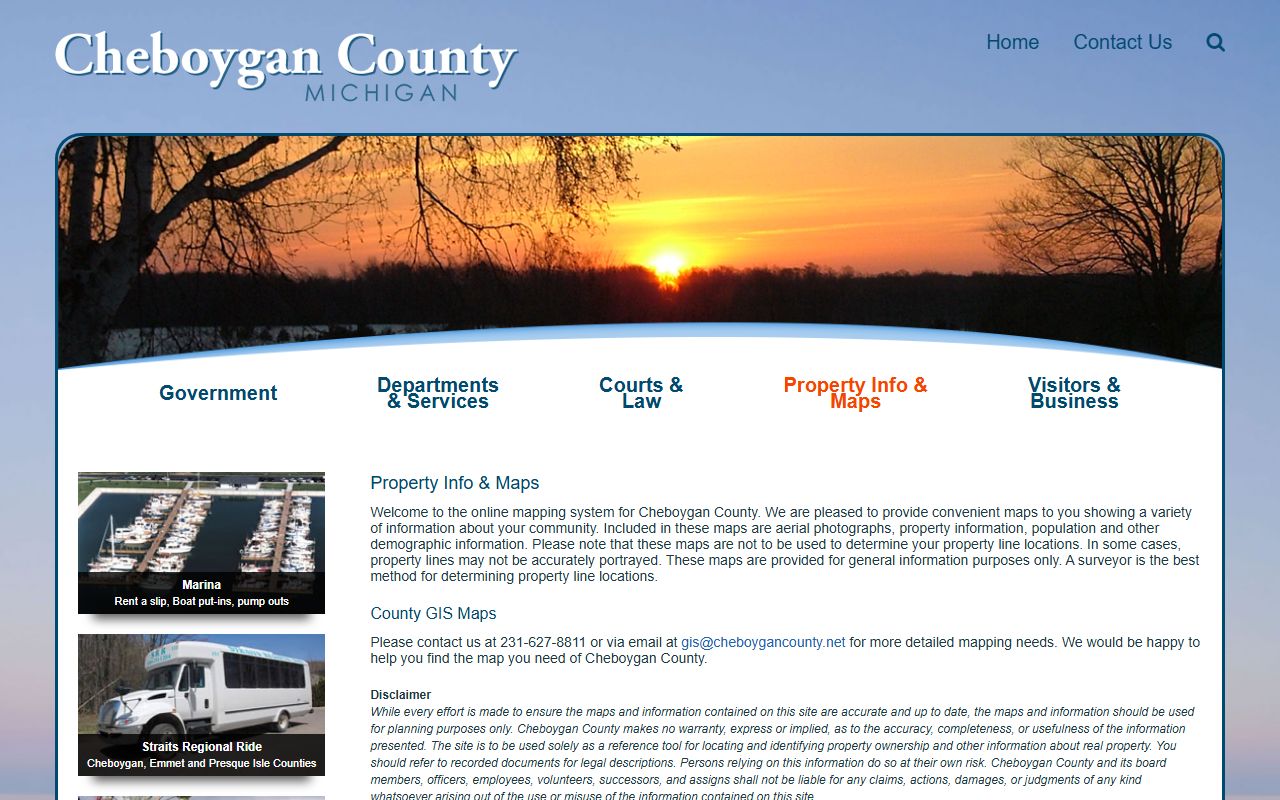
Property and parcel tools help connect a court file to a physical location, which matters for foreclosures, liens, and recorded judgments. The main record categories are:
- Criminal records - complaints, arraignments, pleas, convictions, and sentencing, split between the District and Circuit Courts.
- Civil records - general civil cases, small claims, landlord-tenant matters, orders, and judgments.
- Family and divorce records - divorce, custody, support, and paternity through Circuit Court, with divorces also recorded by the register of deeds.
- Probate records - estates, guardianships, conservatorships, and mental-health matters through the Probate/Family Court.
- Traffic records - citations and infractions through District Court, separate from state driving records.
What Cheboygan County Court Records Show
The county's public displays are event-based more than document-based. A circuit docket display page uses fields such as party name, hearing time, hearing information, case number, and CTN, which is the court tracking number. That tells you the public view surfaces schedule and case identifiers first, and full pleadings or attachments are not always posted online.
For a typical circuit or district case file, the meaningful fields are the ones a searcher can expect to see or ask for by name. The Michigan Courts records-management standards shape how trial courts keep and release this data.
Michigan's trial court records-management guidance sets the framework behind what a local docket shows.
Statewide records-management rules explain why every Michigan county, including Cheboygan, shows similar case fields in its public view. The core fields are outlined below.
| Field | What It Shows |
|---|---|
| Case Number | The unique file identifier assigned by the court. |
| Filing Date | When the case was opened with the court. |
| Parties | The people or businesses named, plus their attorneys. |
| Charges / Cause | The criminal charge or the civil basis for the case. |
| Hearings | Scheduled dates, times, and hearing type. |
| Disposition | The outcome, such as a plea, verdict, dismissal, or judgment. |
Note: Online case search usually surfaces case metadata and hearing scheduling before it shows every underlying filing.
Public Access Laws for Cheboygan County Court Records
Most county records that are not court files are governed by the Michigan Freedom of Information Act. It gives the public a right to inspect and copy records held by county offices, sets the clock for a response, allows reasonable fees, and creates an appeal path when a request is denied. The county maintains a dedicated FOIA page that explains how to file a request with its offices.
Court case files follow the Michigan Court Rules and the courts' own public-access practices rather than FOIA, but the same public-record spirit runs through both. The county's FOIA page is the entry point for records held outside the courts, such as sheriff reports and administrative files.
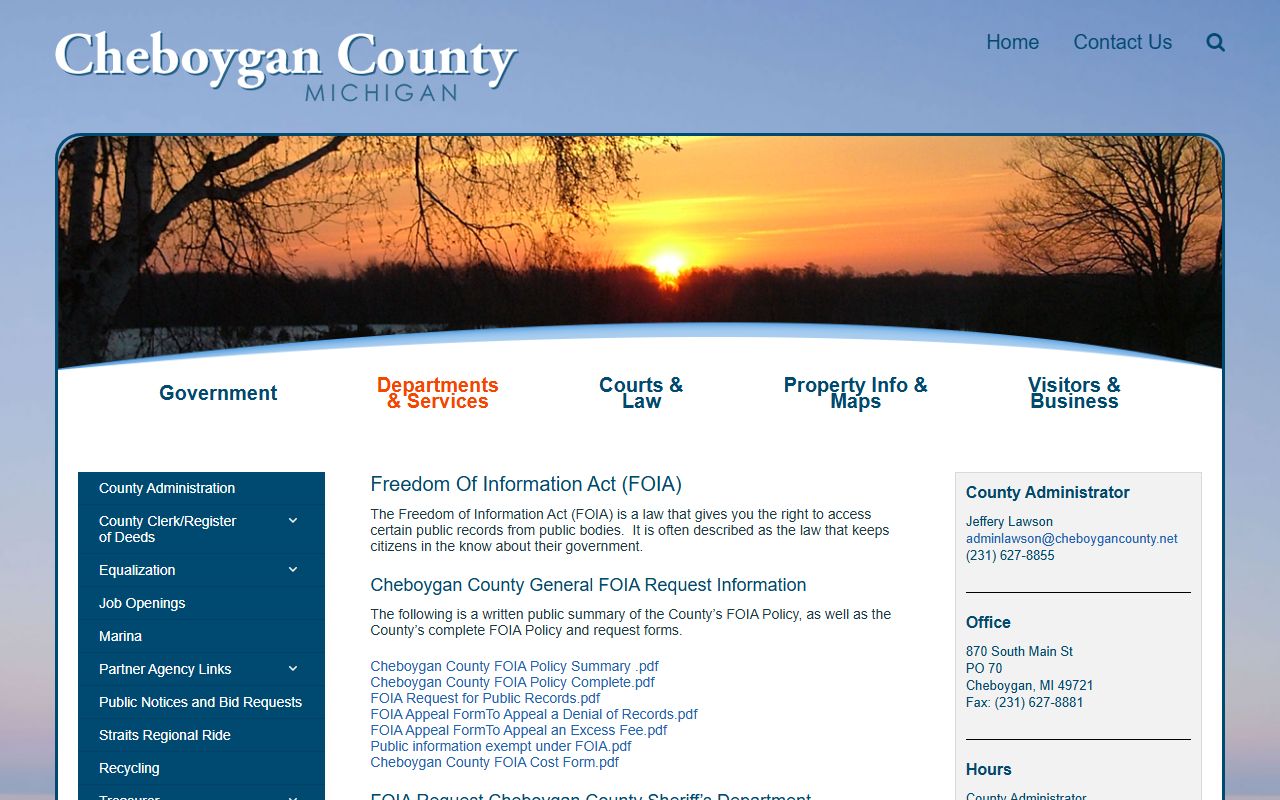
The county FOIA page routes a records request to the right department and lays out the response timeline. The key statutes are summarized here in plain terms.
Key Statutes:
Michigan Compiled Laws § 15.231 - establishes the public's right to inspect and copy public records held by state and local agencies.
Michigan Compiled Laws § 15.233 - sets how a person makes a request and how the agency must respond, generally within five business days.
Michigan Compiled Laws § 15.234 - lists the exemptions that let an agency withhold or redact sensitive material.
Michigan Compiled Laws § 15.235 - governs the fees an agency may charge and how it must itemize them.
Michigan Compiled Laws § 15.240 - creates the appeal and enforcement path when a request is denied.
Records That Are Restricted or Confidential
Not every court record is open to the public, and Cheboygan County is direct about the limits. The Probate/Family Court states that juvenile delinquency, neglect and abuse, and adoption matters are not public. Those files are sealed by category, so they will not appear in a routine name search no matter which portal you use.
Personal identifying information is also protected across court files. Michigan court guidance shields dates of birth, driver's license numbers, state-issued ID numbers, passport numbers, and financial account numbers. Expunged or set-aside convictions drop out of public view once a court grants relief, and some criminal filings involving protected juveniles stay closed as well.
When a record is sealed, the way in is a court motion, not a website. A person with legal standing can ask the court that holds the file to allow access or to unseal it. Common examples of restricted content include:
- Juvenile delinquency, neglect, abuse, and adoption files.
- Protected identifiers such as dates of birth and account numbers.
- Convictions that have been expunged or set aside.
- Ongoing investigative material not yet released by the sheriff.
Specialty Courts in Cheboygan County
Michigan counties run problem-solving courts that work alongside the standard docket, and Cheboygan County's version sits under the 53rd Circuit Court. The circuit court operates a recovery court, a specialty program that pairs supervision with treatment for eligible defendants whose cases are tied to substance use. These programs aim to reduce repeat offenses by combining court oversight with services rather than a straight sentence.
Recovery court participants are still part of the circuit court's public case system, but the day-to-day program details, eligibility, and treatment terms are managed through the court rather than an online record. A person who needs current information about the program should contact the circuit court directly.
Because the county runs a single shared courthouse campus, specialty court hearings and standard hearings use the same building and the same clerk structure, so records still route through the circuit court and the county clerk.
Cheboygan County Sheriff and Jail
The Cheboygan County Sheriff operates from the same Main Street complex as the courts and runs the county jail, a 103-bed facility that holds pretrial detainees and people serving sentences of one year or less. The jail is a short-term county facility, not a long-term prison, so custody there tends to be measured in days or months rather than years. The county does not publish an online public inmate roster in its official pages.
The sheriff's office is also the records channel for police reports, which can take five to ten business days and are not released until an investigation is closed. Because there is no public warrant portal either, warrant questions run through sheriff contact, court checks, and formal records requests.
For custody details, visitation, and the state prison locator, see the county inmate records page, and for active-warrant guidance see the warrant records page. Key points from the sheriff and jail pages include:
- Jail capacity is 103 beds for pretrial and short-sentence custody.
- Visitation is appointment-only, scheduled at least 24 hours ahead.
- No public county inmate roster appears in the official sources.
- Police reports follow the Michigan FOIA response timeline.
Marriage, Divorce, and Probate Records
Marriage and divorce records are a county clerk story with a state vital-record backstop. The County Clerk/Register of Deeds issues marriage licenses, keeps local vital records, and records divorces through the register of deeds side, while certified copies for many purposes come through the state's vital-records system. Probate records are separate again and sit with the Probate/Family Court, which also carries the strictest confidentiality rules in the county.
For the license and filing side, see the county marriage and divorce records page, and for estates and guardianships see the probate records page. A few probate terms come up often:
- Testator
- The person who made a will that a court reviews after death.
- Executor
- The person named in a will to carry out its instructions and settle the estate.
- Conservator
- A person a court appoints to manage the finances of someone who cannot manage them alone.
Cheboygan County Court and Clerk Fees
The clearest published fees in the county come from the clerk's marriage and divorce services, and they give a real sense of what a records-office visit costs. The clerk accepts cash, check, debit, and credit cards, with two narrow limits: no debit or credit for concealed pistol license applications or renewals, and no coin payments over $5. Phone card payments are available for most services except those pistol license transactions.
Marriage licensing and divorce filing carry the fees below. Certified copies of statewide vital records are handled through the state and are priced separately from these county filing fees.
| Item | Amount |
|---|---|
| Marriage license (in-state resident) | $20 |
| Marriage license (out-of-state) | $30 |
| Three-day waiting-period waiver | $15 |
| Divorce filing with minor children | $255 |
| Divorce filing without minor children | $175 |
| In-pro-per divorce packet | $30 |
Cheboygan County Courthouse Location and Contact
Cheboygan County is not a multi-campus court county. The courthouse, the clerk, both trial courts, the probate court, and the sheriff's jail all cluster at 870 South Main Street in Cheboygan, with PO Box 70 used for mail. That single-campus setup means most court business, from certified copies to bond posting to probate filings, happens under one roof.
The county keeps a general contact page for reaching departments and confirming current hours. The county contact page lists the main channels for the courthouse complex.
The contact page gathers the county's court and office numbers in one place, which is helpful when a record does not appear online. The main offices are listed below.
County Clerk/Register of Deeds
870 South Main Street, Room 204
Cheboygan, MI 49721
(231) 627-8808
Probate/Family Court
870 South Main Street, Room 212
Cheboygan, MI 49721
(231) 627-8823
How to Interpret Cheboygan County Court Records
Court files use shorthand that can trip up a first-time reader. A charge is only an accusation, while a conviction is the court's finding of guilt after a plea or a trial. A dismissal means the case ended without a conviction, and a disposition is simply the final outcome of the case, whatever form it takes.
In a District Court traffic file, a plea can be an admission, an admit with explanation, or a deny, and the county accepts those pleas in person, through a representative, by email, or by mail. A default judgment appears when a person does not respond in time. In a criminal file, entries move in a chain from charge to arraignment to plea or trial to sentencing, so reading the entries in order tells the story of the case.
Note: A charge on record does not mean a conviction, so check the disposition before drawing any conclusion about a case.
History and Local Color of Cheboygan County
Cheboygan County brands itself as Michigan's Shoreline County, and that identity is not incidental. The courthouse and jail sit inside a broader civic campus that mixes legal offices with a marina, fairgrounds, trails, roads, and visitor services. A person coming for court records is standing in the middle of a much larger county-government operation, not a standalone courthouse.
The county's public-safety picture is regional. Its pages list non-emergency numbers for the county sheriff and neighboring jurisdictions, which reflects a northern hub where public safety is shared across communities. The county also promotes tourism and business alongside its records services.
The county's visitor and business hub shows how court services live next to everyday county life.
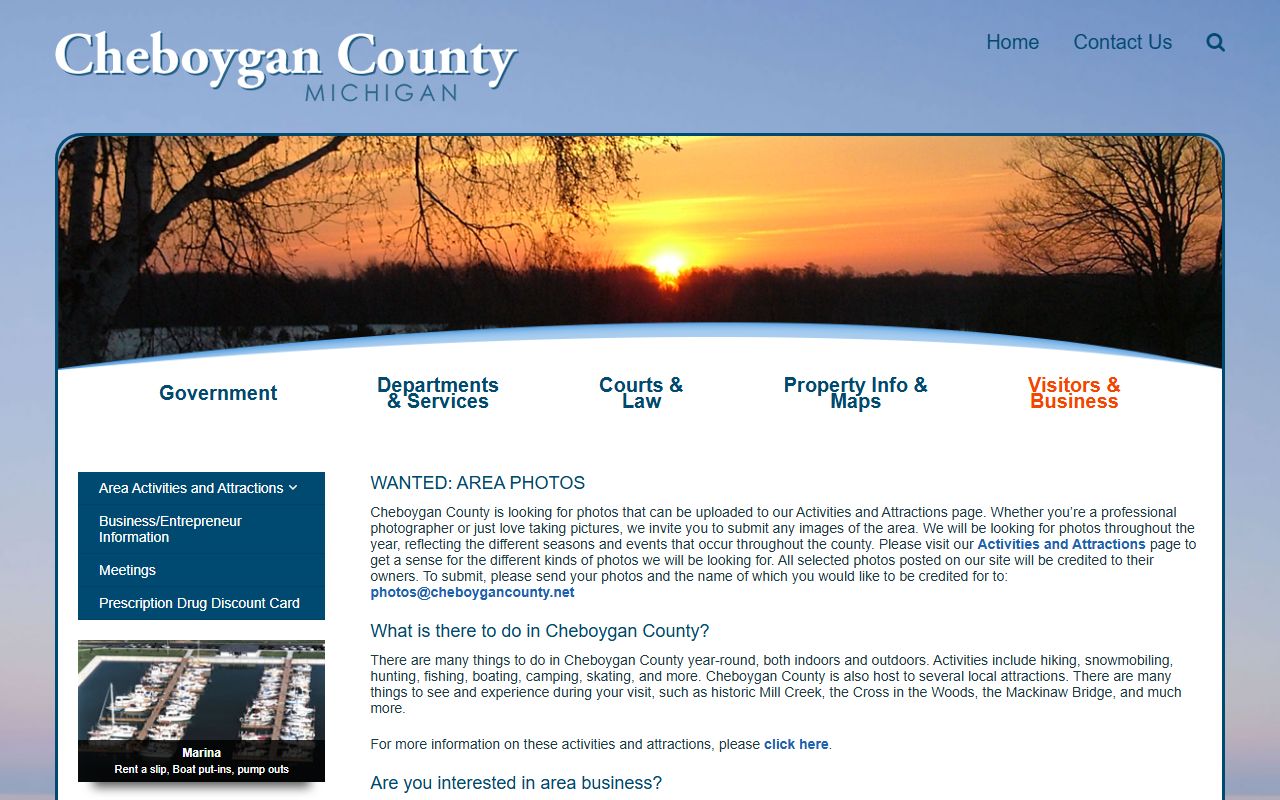
The visitor and business hub underlines the shared-campus character of the county seat, where courts and community services share the same footprint. That single-campus reality is the most useful thing to know before a courthouse visit.
Recent Cheboygan County Court Updates
The county's formal news archive is thin, but real changes still show up. The 89th District Court seated Judge Michael J. Ekdahl, appointed in February 2024, with his term beginning in March 2024, and he serves both Cheboygan and Presque Isle Counties. The circuit court continues to livestream public hearings on YouTube, which keeps hearings visible even when in-person attendance is limited.
The county news page carries a small set of civic posts rather than court headlines, which fits a county that mixes records, roads, and recreation on one site. The county news page is the official spot for those updates.
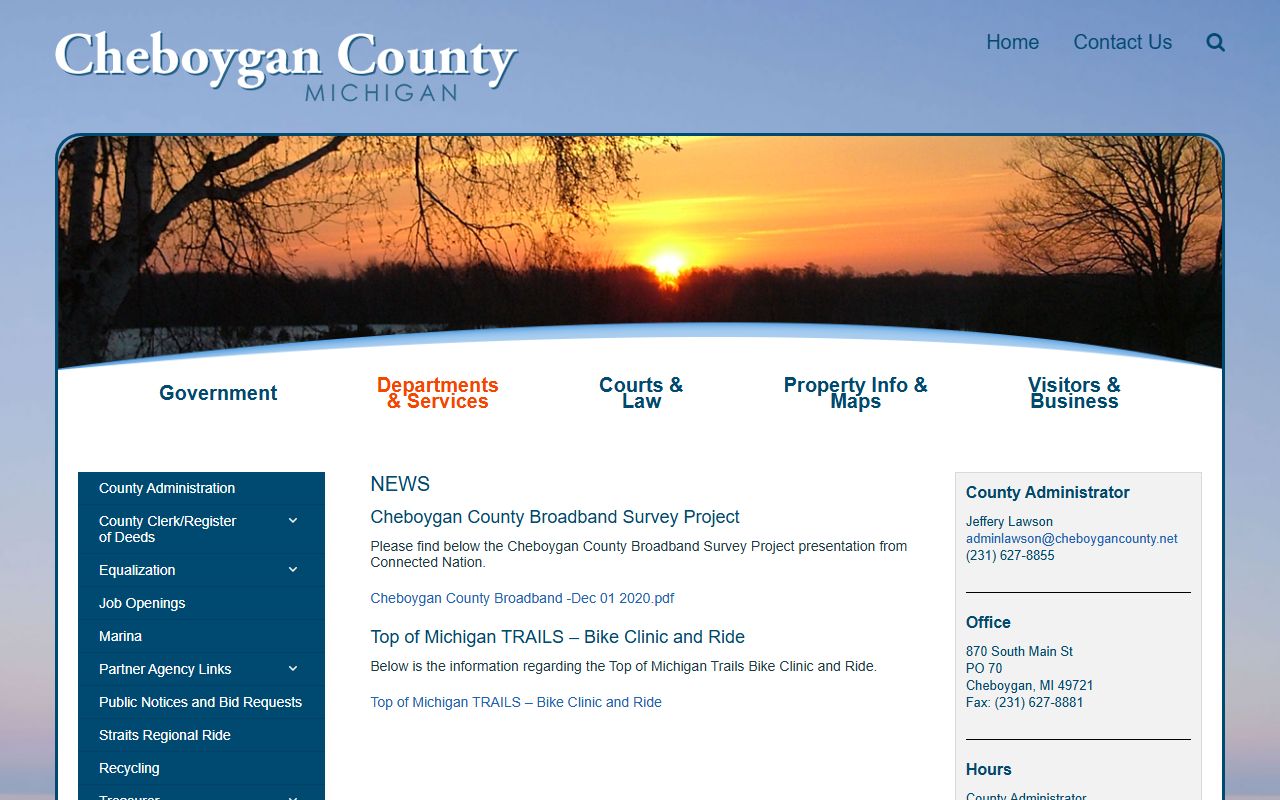
The news page reflects steady digitization rather than dramatic restructuring, with recent posts covering community projects. The strongest recent theme is practical access, seen in a few areas:
- A new District Court judge seated in 2024 for the two-county district.
- Continued circuit court hearing livestreams on YouTube.
- Ongoing use of the statewide MiCOURT case search and state vital-record ordering.
Accuracy and Record Limitations
Public court data is a working system, not a finished archive. Entries can lag behind the courtroom, and the public display often shows hearings and case metadata before it shows every filing. Some records are sealed by category, and some fields are redacted by law, so a clean search is not proof that nothing exists.
Note: Before relying on an online result, confirm the details with the clerk or the court that holds the file, since the public view can lag or omit sealed material.
Frequently Asked Questions
Where do I search Cheboygan County court cases?
Start with the statewide MiCOURT case-search system, which the county links for both its circuit court and its probate court. Set the court level, then search by party name or case number. If the case is not public or does not appear, the clerk's counter or the specific court office is the next step.
Is there a free public inmate roster for the county jail?
No public county jail roster appears in the official Cheboygan County pages. For a person in county custody, contact the sheriff's office or jail directly. For someone in state prison custody, use the Michigan Department of Corrections OTIS locator instead of a county tool.
How do I check for a warrant in Cheboygan County?
The county does not publish an online warrant search. Warrant questions go through the sheriff's office, a check with the district or circuit court for active matters and bond status, and a formal records request where the information is not public.
What does it cost to get a marriage license?
The county charges $20 for an in-state resident marriage license and $30 for an out-of-state license. A waiver of the three-day waiting period costs $15. Both parties must appear in person with photo identification when applying.
Which court handles felonies versus misdemeanors?
The 89th District Court handles misdemeanors and the front end of felony cases, including arraignment and the preliminary examination. Felonies then move to the 53rd Circuit Court for the rest of the case. Traffic and small civil matters stay in District Court.
How do I request a record that is not online?
For court files, ask the clerk or the court that holds the case. For sheriff reports and other county-office records, file a Freedom of Information Act request through the county FOIA page. The agency generally must respond within five business days.